
You spent weeks on it. Finding the story. Chasing the CSM. Scheduling the customer interview. Drafting, editing, taking in another round of revisions, then waiting for the customer to get internal sign-off on their end. (The part nobody accounts for in the project timeline: the story is done, but you're not in control of when it ships.)
Getting it up on the website. Announcing it in Slack.
For a moment, there's genuine excitement. A new case study exists, one that answers a specific question, speaks to a specific pain point, and shows real results.
Two weeks later, a rep pings you. They need proof for a prospect in the exact industry your new case study covers. They know something exists somewhere. They just need you to surface it.
The case study you spent weeks on isn't doing the job you needed it to do. Not because the story is wrong. Because it's sitting in a place your sales team doesn't go.
That's the customer proof paradox. The content exists. The system to get it to sales doesn't. And you can fix it.
The Proof Isn't the Problem. The Location Is.
According to Forrester, 65% of B2B sales content goes unused. Not because it's bad. Because it lives in the wrong place.
Customer success stories get published to a website. Approved quotes go into a Google Drive folder. Case studies get uploaded to a sales enablement platform that most reps open twice a year. The proof exists. It's parked somewhere static while reps are always in motion.
Analysis of 6,500+ real sales queries shows that 66.6% of what reps search for falls into three categories: industry-specific proof, case studies, and similar customer examples. The more telling finding is when they search: during a call or immediately after, when a prospect just raised a doubt that the right customer story could answer. Not before a meeting. Not while browsing a content library on a slow morning. In the moment, when the window to use it is narrow.
That's the gap. Customer proof sitting still in a folder. Need surfacing live on a call. When those two things don't meet, the rep moves on without the proof, and the deal is harder to close.
The fix isn't a better library. It's a delivery layer that gets the right proof to the right rep, in the tools they already use, before they think to ask.
Proof That Finds the Rep Before They Ask
Here's what that looks like in practice.
A seller takes a call with a prospect. During the call, the prospect shares their goals, expresses doubts, and names the outcomes they care about. After the call, Peerbound matches that prospect to similar customers by industry, company size, and use case, and surfaces marketing-approved quotes and case studies. It then matches the specific doubts the prospect raised to quotes and anecdotes from customers who had those same doubts resolved. The rep receives a Proactive Proof email with everything they need to craft a sharp, proof-backed follow-up.
No search. No Slack message to customer marketing. No digging through Drive.
Kerry Wheeler, Director of Product and Customer Marketing at Lattice (a verified Peerbound customer), describes the result directly: "Rather than sales having to ask me or my team for help, Peerbound delivers relevant proof straight to the rep." Her team sent 3,500+ Proactive Proof emails that influenced tens of millions of dollars in won deals, each one matched to a specific prospect conversation and the pain points raised on that call.
At Clari (a verified Peerbound customer), the behavioral shift was immediate. Reps started waiting to send prospect follow-up emails until their Peerbound email arrived so they could include the matched proof. "The value was immediate," said Chris Dalton, Director of Customer Marketing at Clari. "Our reps don't need to search anymore. With Peerbound, customer proof finds the rep, not the other way around."
That's the shift: from proof that waits to be found to proof that arrives when it's useful.
Three Ways to Get Customer Proof Into the Tools Your Team Already Uses
A proof system isn't one channel. It's the right channel for the right moment. Here's how that works across three surfaces.
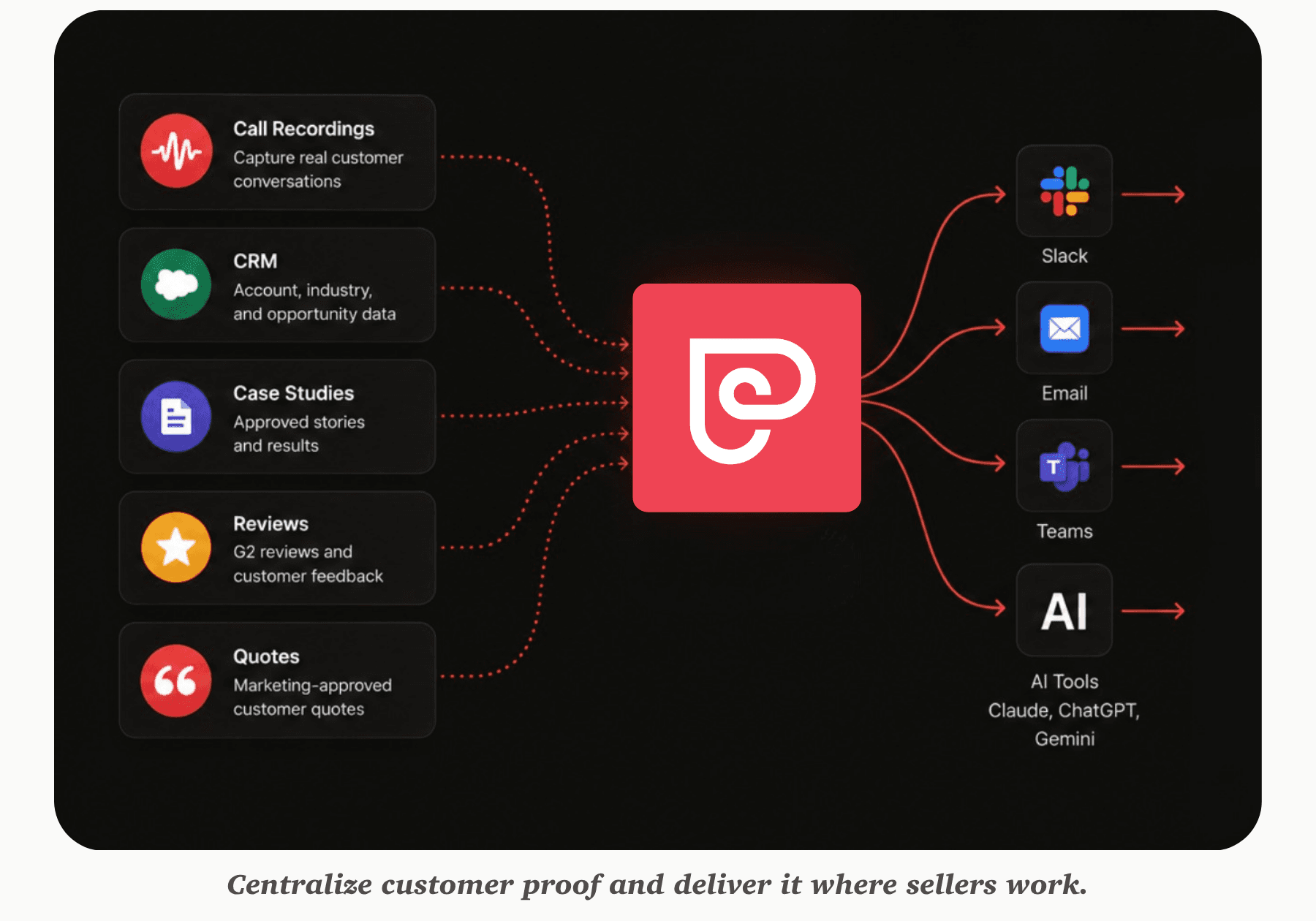
The Slack (or Teams) bot: proof on demand, in natural language. When a rep needs proof mid-deal, the Peerbound Slack app acts as a customer proof answer engine. Reps ask in plain language: "Do we have a quote from a healthcare company with more than 1,000 employees that struggled with rep adoption?" Peerbound surfaces relevant customer stories, quotes, and insights immediately. No new tool. No new login. Kerry Wheeler at Lattice put it plainly: "Rather than a sales rep having to look on the website or an Excel spreadsheet of quotes, it streamlines all of those content basins into one spot. Peerbound has essentially become our customer intelligence library."
Proactive Proof emails: intelligence automatically after every call. Every sales call leaves evidence. A prospect names a competitor. They describe a pain point. They ask a question that reveals where they are in their decision. Peerbound captures those signals and delivers matching customer proof after the call ends: the right case study, the right quote, the right competitive story, timed so the rep can act while the conversation is still fresh. No request needed. No delay.
Peerbound MCP: proof inside the AI tools your company invested in. According to WBR Research, buyers complete 57-70% of their research before they ever speak to sales. They're using AI tools (Claude, ChatGPT, Gemini) to find answers about your product before they request a demo. Peerbound MCP lets those AI tools query your proof collection directly, so your customers' voices are part of that conversation. Internally, it also routes specific moments (competitive proof, ROI evidence, expansion signals) to relevant Slack channels and C-suite digests, embedding customer intelligence into the daily rhythm of the whole company, not just the sales team.
What You Get Back When the System Works
When customer proof is in the workflow, something else happens: customer marketers stop being the workflow.
Before Peerbound, Chris Dalton at Clari described his role as "essentially a human Slackbot.” He went on to say that “Sales reps would ping me often for customer content or ask me where to find it. It was time-consuming and inefficient. These interruptions stopped me from getting more deep work done." Since building a proof delivery system with Peerbound, 100% of new business opportunities at Clari are now impacted by customer proof. The team recovered 20 hours per month in customer marketing, and sales adoption of proof reached levels they hadn't seen with any previous approach.
At Lattice, the transformation was visible across the company. Kerry Wheeler's team went from fielding reactive requests to owning end-to-end proof strategy: discovery, activation, and distribution. "We're not order-takers responding to field requests anymore," Kerry said. "We're strategic partners driving revenue." Her team also saw impact well beyond sales enablement: product teams started using Peerbound to see how customers were talking about features in real time. Customer Success teams got recognized when their conversations surfaced great proof moments. Executives received weekly digests of what customers were saying. Customer proof stopped being a marketing asset and became company intelligence.
Neil Grasso, Customer Marketing Manager at Bonterra (a verified Peerbound customer), names the mechanism that makes adoption stick: "Peerbound has this amazing ability to surface quick customer wins. Now, it's really about moving fast to get approval, and then getting them into sales' hands so they can use them. Your quote approval workflow and agentic proof delivery help us do this automatically, increasing adoption."
The customer proof system your sales team will actually use isn't built on better content. It's built on delivery: getting the right proof to the right rep, at the right moment, inside the tools they already open every day.
Frequently Asked Questions
How can I quickly access customer success stories to help close deals without spending too much time searching?
The fastest path is getting proof delivered to reps rather than asking them to search for it. Peerbound's Proactive Proof emails automatically surface relevant customer stories after every sales call, matched to the specific prospect's industry, company size, and the pain points raised on that call. For on-demand access between calls, the Peerbound Slack app lets reps query in natural language and get answers in seconds. No new platform, no manual search, no request to customer marketing.
How does the Peerbound Slack bot work?
The Slack bot acts as a customer proof answer engine inside the tool your team already uses. Reps ask questions in natural language: "Do we have a case study for a fintech company that improved sales cycle velocity?" Peerbound surfaces matching quotes, case studies, and customer stories from your approved proof collection. It pulls from call recordings, your CRM, G2 reviews, and published case studies, so everything lives in one searchable place. Adoption is built in because there's no new login, no new interface, and no training required.
How do I find and nominate new advocates faster to keep the proof library growing?
Peerbound surfaces potential advocates from the calls, reviews, and CRM notes you already have, without depending on CSM nominations or cold outreach. When customers talk about outcomes they've seen, competitive wins, or specific product use cases, Peerbound flags those moments automatically. That means every advocate conversation starts with you already knowing what the customer will say, which dramatically improves outreach response rates and the quality of the stories you're able to produce.
How do I get my whole sales org, including leadership, to see the value of Proactive Proof?
Peerbound routes specific customer moments to relevant Slack channels across the company: competitive proof to sales, ROI evidence to finance, product feedback to the EPD team, and weekly proof digests to the C-suite. When executives start seeing what customers are actually saying in real time, customer marketing stops looking like a content function and starts looking like a revenue intelligence function. Kerry Wheeler at Lattice described the moment her CEO first received a weekly digest: "I forwarded it inside the company, and people went crazy. Everyone at the company should be able to get a glimpse into what customers are saying."
How to Build a Customer Proof System Your Sales Team Can Actually Use
The proof you're building matters. But the system that gets it to the moment of need, automatically, in the right channel, before anyone has to ask, is what turns that work into revenue.
Clari went from reps pinging customer marketing for proof to 100% of new business opportunities impacted by customer proof. Here's the system behind it.