
What's the difference between Peerbound and UserEvidence? Peerbound extracts customer proof from existing sales calls and reviews, then delivers it to reps via Slack—no surveys required. UserEvidence collects new verified evidence through surveys and organizes it in an evidence library with advocacy workflows. The core difference: Peerbound surfaces proof from conversations already happening; UserEvidence gathers proof you don't have yet.
Peerbound is an AI platform that extracts customer proof from sales calls, CRM data, and reviews, then delivers it to sellers via Slack, email, or Teams in real time.
UserEvidence is a survey-driven platform for collecting verified customer evidence, with third-party review integration and advocacy workflows for enterprise compliance needs.
Forty customers got the quote survey two weeks ago. Three have answered.
You're not refreshing the results tab out of curiosity. A rep just messaged asking for something quotable for a call in an hour, and the only thing standing between you and an answer is whether anyone in that spreadsheet finally clicked submit. You send the fourth reminder this month, one more email landing in an inbox that's already getting an onboarding sequence, an NPS survey, and a renewal check-in, and go back to the call prep you were doing before the ping interrupted it.
If you searched "Peerbound vs. UserEvidence" looking for the honest answer, here it is. If your team doesn't have call recording software feeding you raw material yet, and the only way to get customer feedback is to go ask for it directly, UserEvidence is built for that: a structured way to run surveys, collect reviews, and turn responses into testimonials. If you're running mid-market or Enterprise B2B SaaS org and calls are already happening through Gong, Chorus, Salesloft, or something similar, the problem is usually the opposite: proof is piling up faster than anyone has time to read it. Peerbound is built for that: finding, creating, and delivering the proof already inside your business, continuously, without adding another email to your customers' inboxes.
Here's the honest version of both, side by side.
The one-sentence answer: it depends on whether proof is already flowing in
Who UserEvidence fits best: teams with no call recording software yet, who need a structured way to ask customers directly for feedback, and who can plan around survey response times.
Who Peerbound fits best: B2B SaaS companies with a sizeable sales org (Peerbound's base typically starts around 200 employees) that want customer proof collected, created, and delivered automatically, at the speed and scale call recording makes possible.
Proven results: Grata achieved a 5X increase in customer stories using Peerbound. Iterable reduced case study creation time by 50%. Tipalti cut story turnaround from two months to two weeks.
What UserEvidence actually does
UserEvidence is a survey-first platform. You build a survey, send it to a customer list, and wait for responses, which get compiled into testimonials, ROI stats, and case study templates. It also ingests reviews from G2, TrustRadius, and Gartner Peer Insights, and it has a Gong integration: you search for a specific call by date, conversation ID, or keyword, decide it's worth analyzing, and only then does its AI pull quotes or a case study draft from that one transcript. Its "Evi" assistant lets a rep ask, in plain language, for testimonials matching a segment. None of it moves until a customer answers a survey, someone picks a call to search, or a rep remembers to ask.
Key point: UserEvidence requires survey deployment and customer responses, but provides third-party verification for compliance-focused teams.
What Peerbound actually does
Peerbound doesn't wait on any of those three things. Its Find agent listens autonomously to every sales call, CRM update, and review as they happen, no survey sent and no call to hunt for. It flags eight types of customer intelligence, from competitive wins to ROI evidence to expansion signals, as soon as they show up. None of this strictly requires call recording software: you can manually upload existing recordings, a case study interview, for example, to seed Find, and G2 reviews and CRM data connect independently of any call recording tool. Call recording is simply what gets you there fastest and at the largest scale, since it's what lets Find listen automatically instead of waiting on an upload. Create turns that raw material into stories, quotes, and G2 review drafts automatically, with an approval workflow before anything ships. Deliver gets the finished proof to sellers two ways: a Proactive Proof email that lands in a rep's inbox after a call with a prospect, or on-demand access through Slack, Teams, or whichever AI tool a rep already works in through Peerbound MCP. Once proof is approved, Peerbound for AEO publishes it straight to your website in your customers' own words, so a buyer researching you finds the same quotes a rep would send them. Measure ties every one of those touchpoints back to Salesforce, so you can see which proof actually showed up in deals that closed.
Key point: Peerbound surfaces proof in minutes from existing calls; no survey deployment or customer action required.
How each platform collects evidence
UserEvidence's core method depends on someone else's willingness to answer: a customer opening an email, filling out a form, hoping enough of the list responds before the deadline you need it by. Its own Gong integration runs the same way. Someone has to go looking, search a call by date or keyword, and decide it's worth the AI's time before anything gets pulled from it.
Peerbound's Find agent skips both steps. It reads every call as it happens, whether it's on Gong, Chorus, Clari Copilot, Salesloft, or five other tools, and matches customer intelligence in real time. Nothing depends on whether a customer opens an email today, and nothing depends on a marketer remembering which call to search.
Key point: Peerbound collects evidence automatically from 10+ call platforms; UserEvidence requires manual call selection through Gong only.
Turning a conversation into a finished asset shouldn't take two months
Tipalti (a verified Peerbound customer) used to spend close to two months turning a single customer call into a finished case study: chase the story, wait on the customer, route it through review, wait again. After moving that work to Peerbound, the same process runs in about two weeks, cutting story turnaround 4x and speeding up their G2 review workflow by 70%. They went from around ten case studies a year to eleven in a single quarter.
"The number of quotes you can generate with Peerbound is revolutionary," said Leslie Barrett, Director of Customer Marketing at Tipalti. "The scale is absurd, not just in terms of quantity but also quality and how real-time it is."
The quality point shows up elsewhere too. Jane Menyo, Head of Solutions Marketing at Gong (a verified Peerbound customer), ran a pilot comparing Peerbound-sourced G2 reviews to Gong's traditional review requests: the Peerbound-sourced reviews came back over two and a half times longer, with twice as many product mentions and five times more mentions of specific value propositions. Longer, more specific reviews are what shows up when a buyer's AI tool goes looking for proof before that buyer ever talks to a rep.
UserEvidence produces testimonials and case study templates too, built from a survey response or a manually selected call. The difference is how much has to happen, and how long a customer marketer has to wait, before that output exists at all.
Sellers open whatever answers the question in front of them right now
UserEvidence's Slack integration lets a rep search for relevant content and get notified when a new survey comes back. That's useful, but it's still a rep-initiated search, and it still depends on a survey having been completed recently enough to have something fresh to find.
Peerbound's Proactive Proof reads the actual sales call, identifies the specific doubt a prospect raised, and sends the matching proof to the rep by email, Slack, or Teams before they think to ask. Neil Grasso, Customer Marketing Manager at Bonterra (a verified Peerbound customer), described what that changes day to day: "Peerbound has this amazing ability to surface quick customer wins. Now, it's really about moving fast to get approval, and then getting them into sales' hands so they can use them. Your quote approval workflow and agentic proof delivery help us do this automatically, increasing adoption."
Kerry Wheeler, Director, Product Marketing at Lattice (a verified Peerbound customer), evaluated both platforms directly before choosing: "I evaluated UserEvidence alongside Peerbound last year. UserEvidence required too much additional work, like creating and sending surveys and then waiting and hoping for responses. Peerbound really stood out because it brought everything to me and let me work faster, without needing to wait for survey responses."
10+ call recording integrations means access to proof remains, even if your stack changes
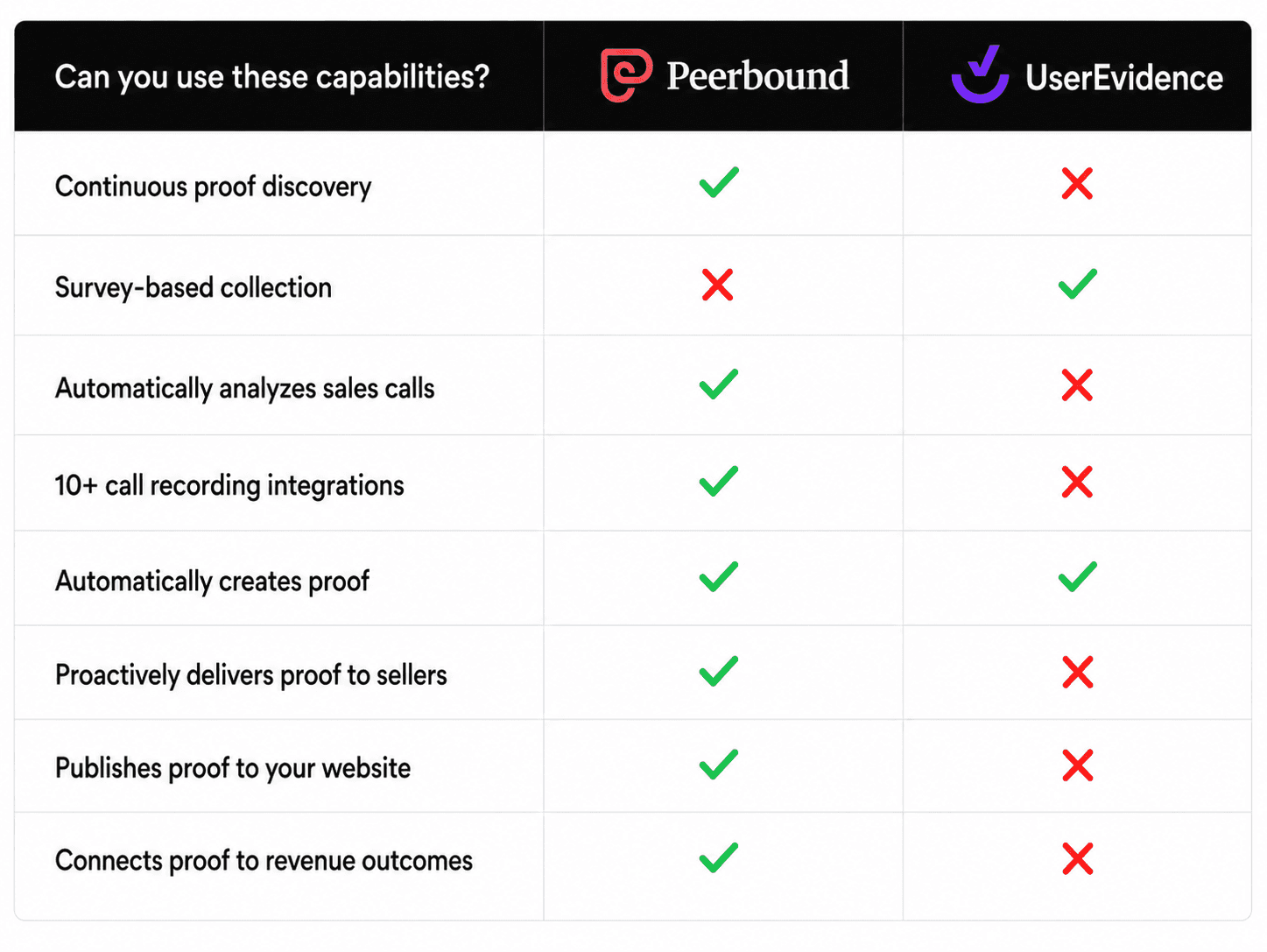
Peerbound connects to Attention, Avoma, Chorus, Clari Copilot, Fireflies, Gong, Goodmeetings, Momentum, Outreach and Salesloft, plus Salesforce, HubSpot, G2, Slack, Teams and your LLM of choice through the Peerbound MCP (now listed as an official Anthropic Connector). UserEvidence's ability to pull proof from a live conversation runs through a single integration, Gong, alongside its connections to Seismic, Highspot, Salesforce, HubSpot, and review sites, which are built for organizing proof you already have rather than capturing new proof from a call as it happens.
If your team's calls run through Chorus, Clari Copilot, Salesloft, Fireflies, Attention, Avoma, Outreach or Goodmeetings instead of Gong, UserEvidence's call-based capture doesn't reach them. Peerbound's does. And if your stack changes, a new sales tool, a switch from Gong to Chorus, a second tool added after an acquisition, your access to customer proof shouldn't have to change with it.
Approval can move as fast as the rest of the workflow
Both platforms gate finished content on someone signing off before it goes external, and that's the right instinct either way. The difference is where that approval step lives. At Tipalti, folding sign-off into the same workflow where the content gets created and shipped, instead of routing it through a separate chain of emails and document versions, is a big part of why case study production dropped from two months to two weeks in the first place.
"We didn't have to train you on the kind of content we want to see," Barrett said. "Peerbound just nails it."
Every touchpoint should tie back to a deal
UserEvidence's own materials describe strong reporting on downloads, shares, survey completion rates, and link activity by channel, which is genuinely useful for running a content operation. What isn't described anywhere in its public materials is tying a specific asset to a specific deal outcome. Peerbound's Measure connects every proof touchpoint, Slack deliveries, email sends, call mentions, straight to Salesforce, so you can see which proof showed up in deals that closed and how win rate moved when it did. A download count tells you a story got opened, but Measure ties it to whether the deal actually closed.
What to ask before you commit budget to either one
Does your team have call recording software running today, and if so, on which platform?
Are you trying to collect proof you don't have yet, or trying to get proof you already have in front of sellers faster?
Who has to act before a piece of proof exists: a customer, a marketer searching a transcript, or no one?
Where does approval happen, and how long does it typically take?
Can you trace a specific piece of proof to a specific deal outcome, or only to a download count?
Where Peerbound fits
UserEvidence collects customer evidence by asking directly, mainly through surveys, plus review-site ingestion and a Gong integration that requires manually selecting a call to analyze. Peerbound continuously listens across every sales call, CRM update, and review, then creates and delivers the proof automatically, without a survey or a manual search.
Do I need call recording software to get value from Peerbound?
What's the difference between Peerbound and UserEvidence?
UserEvidence collects customer evidence by asking directly, mainly through surveys, plus review-site ingestion and a Gong integration that requires manually selecting a call to analyze. Peerbound continuously listens across every sales call, CRM update, and review, then creates and delivers the proof automatically, without a survey or a manual search.
Do I need call recording software to get value from Peerbound?
No. Call recording is the fastest route to full value, since it's what lets Peerbound's Find agent listen to every call automatically, but it isn't a requirement. You can manually upload existing recordings, like case study interviews, to start building a proof library, and G2 reviews and CRM data connect independently of any call recording tool. Call recording is what adds speed and scale on top of that foundation, not the only way in.
Can I keep running customer surveys after switching to Peerbound?
Yes. Peerbound doesn't require abandoning an existing survey program. The two approaches solve different intake problems, so a team can keep surveys running where there's no call happening to listen to, while letting Peerbound handle the proof already sitting in calls, CRM records, and reviews.
How fast can Peerbound turn a sales call into a case study or G2 review?
At Tipalti, moving story production onto Peerbound cut turnaround from close to two months to about two weeks, a 4x improvement, and sped up their G2 review workflow by 70%. Actual turnaround depends on how quickly a customer signs off during the approval step.
Does Peerbound integrate with G2, TrustRadius, or Gartner Peer Insights?
Peerbound integrates with G2 today. If your reviews live primarily on TrustRadius or Gartner Peer Insights, check with your CSM before assuming the same coverage.
See exactly how Tipalti cut case study production from two months to two weeks and published 2.5x more stories a quarter: read the full Tipalti case study.
Which is better for B2B SaaS: Peerbound or UserEvidence?
UserEvidence collects customer evidence by asking directly, mainly through surveys, plus review-site ingestion and a Gong integration that requires manually selecting a call to analyze. Peerbound continuously listens across every sales call, CRM update, and review, then creates and delivers the proof automatically, without a survey or a manual search.
For B2B SaaS companies with 200+ employees and existing call recording infrastructure, Peerbound delivers faster time-to-proof. For teams without call recording who need structured survey collection with third-party verification, UserEvidence fits that workflow.
Key Takeaways
Peerbound's speed advantage: Surfaces proof in minutes from existing calls—no surveys, no waiting on customer responses. Tipalti cut case study turnaround from 2 months to 2 weeks.
UserEvidence's verification strength: Third-party verified surveys provide compliance-ready evidence for enterprise teams with strict approval requirements.
Integration flexibility: Peerbound connects to 10+ call recording platforms; UserEvidence's call integration is Gong-only.
Best for sales-driven teams: Peerbound's proactive Slack delivery gets proof to reps before they ask. UserEvidence requires rep-initiated searches.
Best for survey-dependent orgs: If you don't have call recording software and need to collect new customer feedback, UserEvidence provides that structured workflow.
Peerbound vs. UserEvidence. UserEvidence surveys customers for proof you don't have yet. Peerbound finds and delivers the proof already in your sales calls.