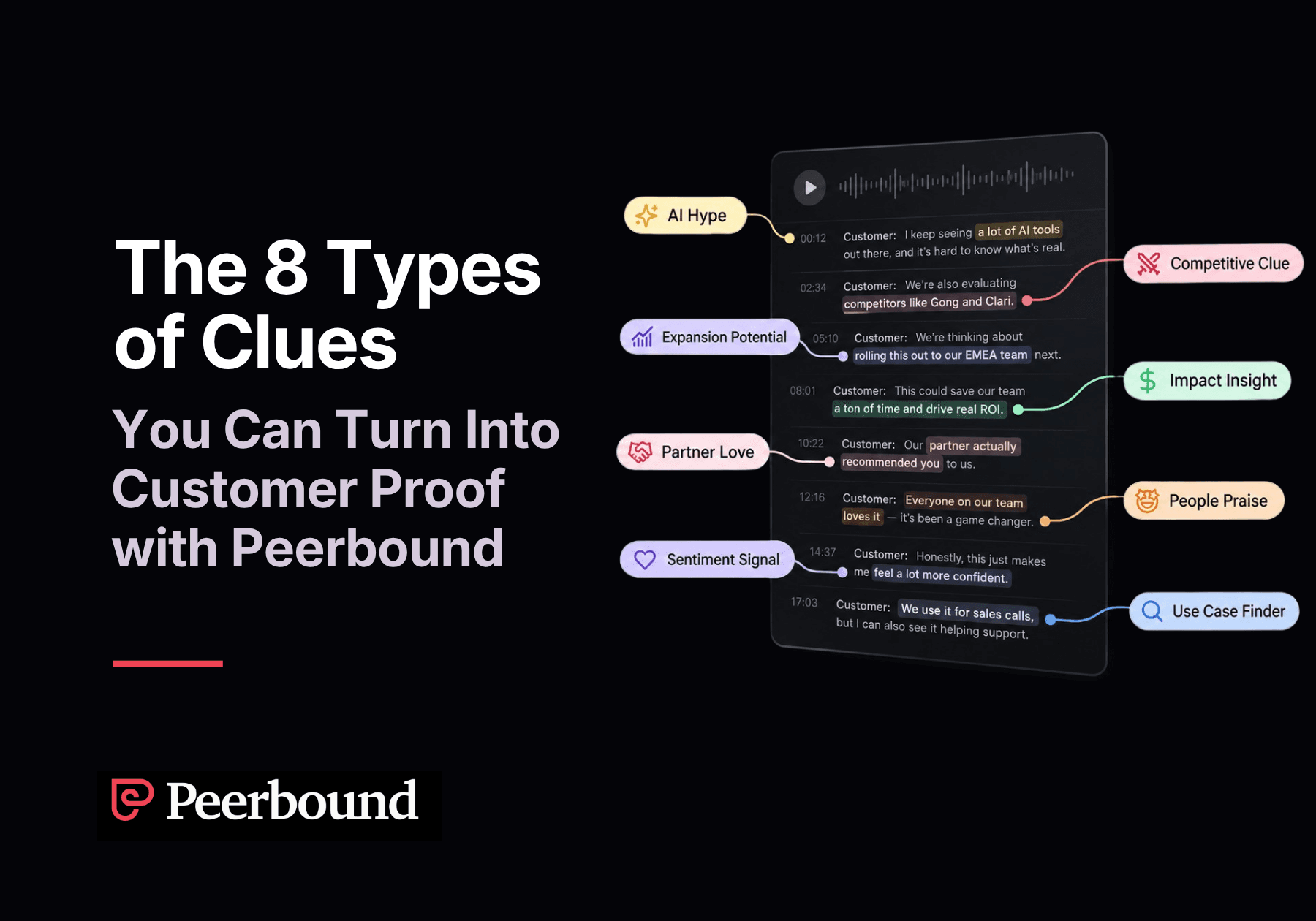
The old way of finding advocates looks like this: get a logo nomination, find the contact, hop on a call… then discover what they'll actually say.
That's backwards.
Because your CEO doesn't care how many "advocates" you have. They care about what customers credibly say about your company, and whether you can use it to win deals.
In our latest Customer Marketing Masterclass, Kerry Wheeler, Director of Product and Customer Marketing at Lattice, joined Sunny Manivannan, Founder and CEO of Peerbound to share how her team transformed their approach to customer advocacy by flipping from advocate-first to proof-first, and the results speak for themselves.
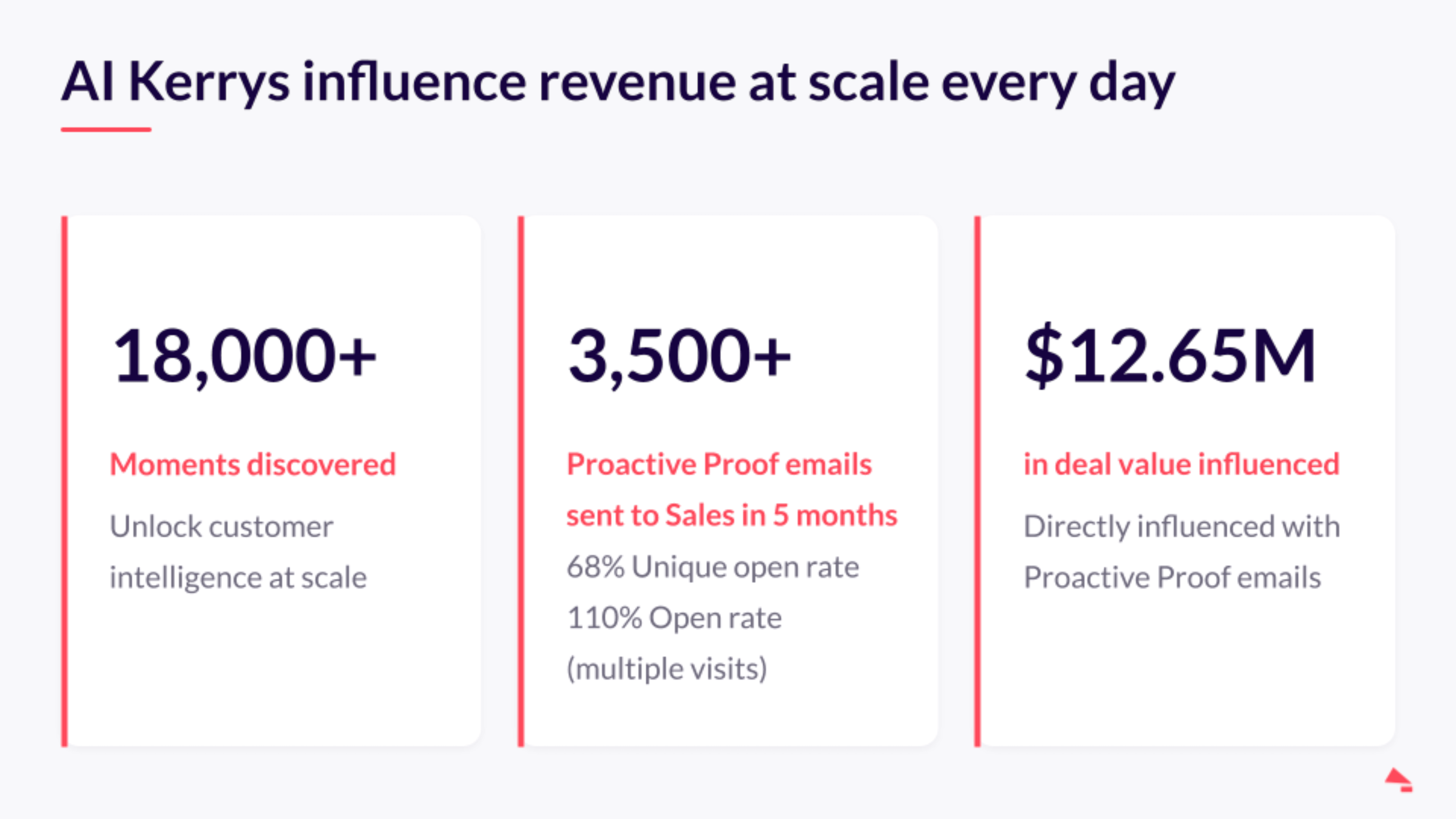
18,000+ moments discovered in the last year. These positive proof statements were surfaced automatically from customer calls, G2 reviews, and case studies, and would have been impossible to surface manually.
3,500+ Proactive Proof emails which influenced tens of millions of dollars in won deals. Each one matched to a specific prospect conversation and pain points.
Demo requests from customer stories now have a higher close rate than other inbound leads. When prospects see themselves in your customers' stories, they convert.
But the impact goes beyond metrics.
If you've ever spent hours hunting for advocates only to end up with fluffy testimonials that don't move the needle, here's what you need to know.
The Backwards Advocacy Playbook (And Why It's Broken)
Most B2B companies run their advocacy programs the same way: get logo nominations, identify contacts, do discovery calls with CS and Sales, search through call transcripts and CRM notes, and hope they find something useful.
Kerry's team at Lattice used to do the same thing.
"It was super manual, and it was very much a reactive process," Kerry explained. Which meant mining through Salesforce data, looking at health scores, tenure, what products customers used. But even with all that data, the results were hit or miss.
"You reach out and maybe they don't have the use case you're hoping they have. Or you don't hear back. Or you get something, but it's not exactly what you need," Kerry said. The result? "Stories that were very fluffy. They sounded nice but weren't necessarily helping our business objectives."
What "Proof-First" Actually Means
Instead of hunting for willing advocates and hoping they say something useful, Lattice flipped the model entirely:
Find what customers are already saying → Identify who's saying it → Activate them
“By using Peerbound's customer intelligence platform, we can now dig in and have eyes into what our customers are saying across different touchpoints with Sales and CX," Kerry explained. "If we know we have a new product coming out, we can look and see what customers have already been talking about the topic. Or if we want to build stories around how teams are building good habits with Lattice, we can see who's implementing them."
The shift means starting with evidence rather than assumptions.
"It allowed us to find much higher quality advocates. We start with the evidence versus trying to start with what we want and fitting people into that."
And because these customers are already fans, the outreach success rate jumped dramatically.
"We have reduced the back and forth of reaching out and getting ghosted or getting a no," Kerry said. "Because we're starting with folks who already love Lattice, are talking about their success, and are eager to share their stories."
How it Works: The LiveRamp Case Study
Last year, Lattice was preparing to announce a partnership with Workday. To support the launch, they needed to highlight customers who were already using Workday and Lattice together successfully.
"Rather than having to crawl through our CRM tosee who was using Workday and guess what their experience looked like from there, we went straight into Peerbound," Kerry explained.
Step 1: Search and filter proof. Kerry searched Peerbound for customers already talking about Workday and Lattice together, and also used Peerbound to drill down into the enterprise segment.
Step 2: Start with quote approval. Instead of cold outreach asking for a favor, Kerry used Peerbound to send quotes that she'd found and asked LiveRamp for usage approval. "That kicked off the conversation and got us talking with them."
Step 3: Expand the relationship. After the initial quote approval, Kerry asked if LiveRamp would be willing to do a full customer story. "They were excited to do it. Going through Peerbound and already knowing they're saying great things made that an easy get."
Step 4: Invite to the beta. After the story was published, Lattice invited LiveRamp to join their beta program to test a new Workday integration.
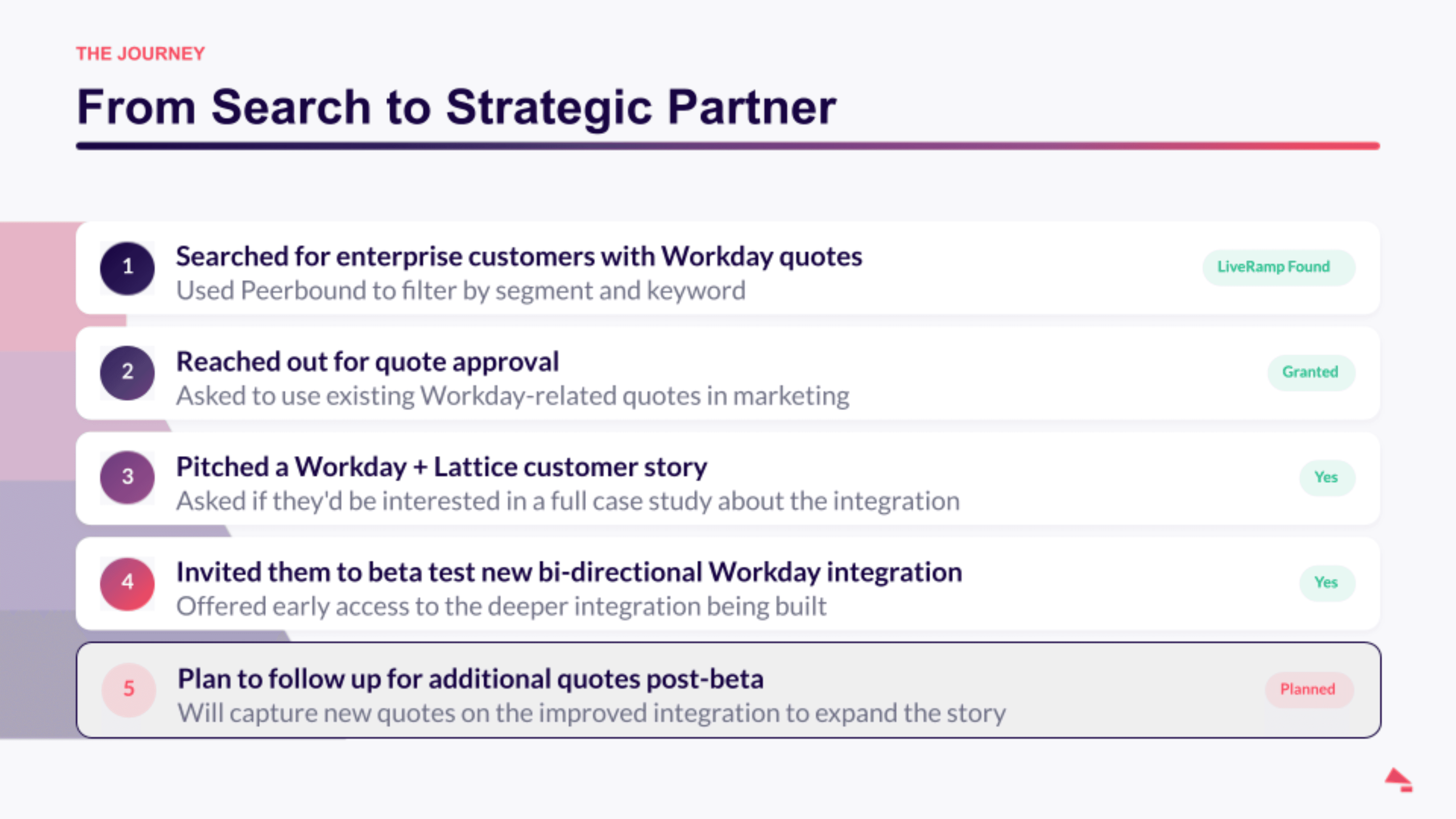
"It went from a quote to a case study to a beta integration partner," Kerry said. "That's where the strategic part of customer marketing really gets seen as we provide value to EPD teams, versus just turning out case studies."
From One Kerry to Ten Kerrys
"Everyone has probably felt this way at some point," Kerry said. "You're getting pings from ten million sales reps asking for different customer references in different segments. You're getting asked to write and find customer quotes to support an upcoming launch. There's so much to react to."
Here's how Lattice scaled:
The Peerbound Slack integration became a game-changer. "I cannot speak highly enough of Peerbound’s Slack integration. It was the first thing we launched and truly became one Kerry who is just dedicated to answering Slack questions. I'm so thankful for it."
Sales reps can now ask hyper-specific questions directly in Slack: Do we have a quote from a company who's more than 1,000 employees, based in Europe, using a specific product? Peerbound surfaces exactly what they need.
"Rather than a sales rep having to look on the website or an Excel spreadsheet of quotes, it streamlines all of those content basins into one spot," Kerry explained. "Peerbound has essentially become our customer intelligence library."
Proactive Proof emails deliver intelligence automatically. After every sales call, reps receive an email matching them with relevant customer proof based on the prospect's attributes and conversation topics.
"Proactive Proof emails allow our reps to be more consultative and to naturally and organically pull in references without feeling too salesy, rooting outreach in actual outcomes that our customers have seen," Kerry said. The bonus: "rather than sales having to ask me or my team for help, Peerbound delivers relevant proof straight to the rep."
Sales knows who customer marketing is now. With 3,500+ Proactive Proof emails sent which influenced millions in won revenue, "everyone on our sales team knows who we are," Kerry said. "We're not order-takers responding to field requests anymore. We're strategic partners driving revenue."
Delivering Org-Wide Impact
Kerry emphasized that customer intelligence isn't just for customer marketing anymore. At Lattice, it's embedded across the company.
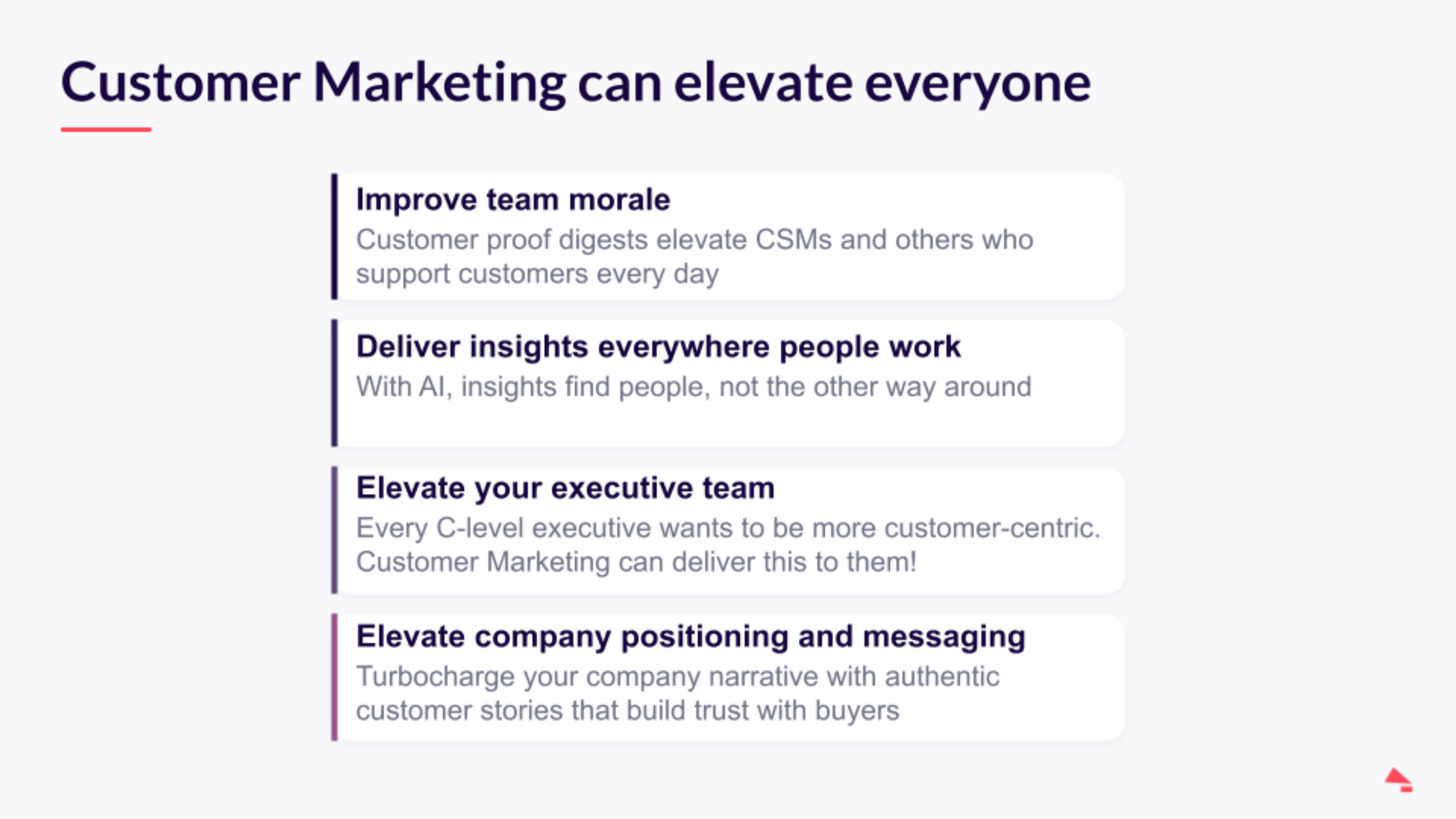
Team morale. "One of the most unexpected impacts has been on internal morale," Kerry shared. "We now share proof moments across company Slack channels, so CS reps get recognized for great work, product teams see customers praising features they built, and engineers who worked on new products actually hear how customers are using them. It's become one of the most looked-forward-to things in the week."
Product roadmapping. "We're in the roadmapping process right now. Peerbound has been really helpful because we're able to see if customers are using specific features or asking for new use cases, and we can bring those insights directly into the product development."
Executive visibility. "I remember the first time I got a Peerbound digest email of all the proof moments from that week. I went directly to my boss and our CEO, and forwarded it along inside the company, and people went crazy. Everyone at the company should be able to get a glimpse into what customers are saying."
Company positioning and messaging. "We're currently refreshing our positioning at Lattice. It's been a great way to see exactly how people are talking about things like manager effectiveness and what they're looking to achieve with Lattice. It's a lighter weight way to get Voice of the Customer integrated into everything we do."
Customer marketing owns the end-to-end process. Previously, marketing's job was to create proof assets and hope Sales would use them. Now, Kerry's team owns everything from discovery to activation to distribution, with AI-powered customer intelligence handling the scale.
The transformation? Moving from firefighting to forward-thinking.
"It reduced so much of the friction that customer marketers often feel," Kerry said. "It frees us up to be really strategic and thoughtful about the work we're doing and how that rolls up to overall company objectives."
Key Takeaways
1. Your best advocates haven't met you yet.
Stop hunting for willing participants. The customers saying the most valuable things about you don't know they're advocates yet. Find the proof first, then work backwards.
2. Less high-impact proof beats lots of fluff.
Three stories that resonate with both the HR rep and the CFO will outperform fifty generic testimonials. Recalibrate what you care about highlighting.
3. Sales will adopt what saves them time, not what creates work.
Lattice's reps spend a couple minutes reading proof emails and immediately repurpose the intelligence into deals. Adoption isn't about training, it's about eliminating friction and delivering value where your team already works.
4. Don't overthink the launch.
Kerry's advice: "The Slack integration was the first thing we launched. It truly became one Kerry dedicated to answering Slack questions." Start there, let adoption build organically.
5. Customer intelligence elevates the entire function."When customer marketing starts to provide value to EPD and other business functions, versus just turning out case studies, that's where the strategic part of customer marketing really gets seen.”
What's Next?
If you're ready to flip your own advocacy funnel, we'd love to show you how Peerbound can help.
Book a demo to see how customer marketers are using AI-powered customer intelligence to discover proof at scale, just like Lattice.
See how Lattice surfaced 14,000+ customer moments and attributed millions in won revenue using a proof-first customer advocacy strategy.