It's Monday pipeline review, and your boss wants the number. Not the activity report, the business impact: how much of last quarter's pipeline actually closed because of the advocacy program you got budget for. You can answer the activity part fine: ten case studies in motion, thirty advocates activated, eighteen reference requests fulfilled, on time, no complaints. Then she asks what any of that did to a deal, and nobody says anything for a second, because the tool you bought to fix this was supposed to answer that question for you. Instead you're the one explaining, again, why "orchestration" isn't the same thing as attribution or proof anyone can point to.
This is a common challenge with customer marketing platforms, and one that puts customer marketers in an awkward position when it comes to the conversation around impact and ROI.
A customer marketing manager's job breaks down into five main pillars: publish case studies, run the customer advisory board or executive sponsor program, generate customers reviews for sites like G2, fill reference requests, and book advocates for events and webinars. Every one of those exists to accelerate pipeline, increase win rates, or improve deal velocity. "Customer orchestration," the category Deeto has built its platform around, doesn't name a single one of them. It describes coordinating feedback across sales, CS, and product, which sounds like infrastructure and functions like one, but it isn't a job you get measured on. A platform built around a coordination layer has nothing concrete to be held accountable to, and that’s where the credibility problem starts: you get the budget, you run the rollout, and six months later you're still explaining what it did.
What "customer orchestration" promises, and what actually ships
To be fair to Deeto, the company has moved well past a simple reference-request tool. Its current platform is built around five capabilities it calls Listen, Learn, Analyze, Activate, and Integrate, covering everything from call and feedback capture to sentiment analysis to routing insights into sales, marketing, and product workflows. A platform update announced in January 2026 (Business Wire) added Gong ingestion, deeper HubSpot and Salesforce workflows, G2 synchronization, and an MCP server for querying customer content programmatically. This has moved well past a thin reference tool, and treating it as basic undersells what a customer marketing team is actually evaluating.
But the gap between what "orchestration" promises and what a customer marketer needs shows up clearly in Deeto's own G2 reviews, and it clusters around the same three places every time.
The first is measurement, and it's the sharpest one. A Sr. Customer Advocacy Manager wrote that she finds the analytics "extremely lacking" and wants more functionality to measure business impact; a Head of Customer Marketing described the native insights as falling short of tying activity to revenue, with Salesforce reporting that "didn't really work" for her team. Translated into a Monday morning: you can tell your boss how many stories you sourced. You still can't tell her what any of it did to a deal, which is the exact question orchestration was supposed to make easy to answer.
The second is scale. One reviewer flagged limited language support as a real barrier to rolling the program out globally, to the point that expanding into new markets meant standing up a separate environment rather than extending the one she already had. A tool bought to remove operational complexity starts handing some of it back the moment the program grows past a single region.
The third is content quality. G2's review summary for Deeto flags AI-generated content as a weak point, and one Managing Consultant put it bluntly: the AI-written customer stories "need some work" and don't feel ready to put in front of a customer without a rewrite. Generating a draft isn't the same thing as producing proof a customer marketer would stake her name on. The software can write something quickly; whether it's accurate, specific, and something the customer would actually approve is still the marketer's job, every time.
None of this means Deeto customers are broadly unhappy. The public review set is small and mostly positive, and several reviewers also cite sporadic bugs as new functionality has rolled out, which is a normal cost of a platform expanding this fast, not a red flag on its own. But if your five jobs depend on tying proof to revenue, scaling a program for a global company, and shipping content you'd sign your name to, it's worth knowing exactly where the category's edges are before you buy into it.
Six platforms customer marketers actually put on this list, ranked
1. Peerbound: the platform built for the five jobs on your desk
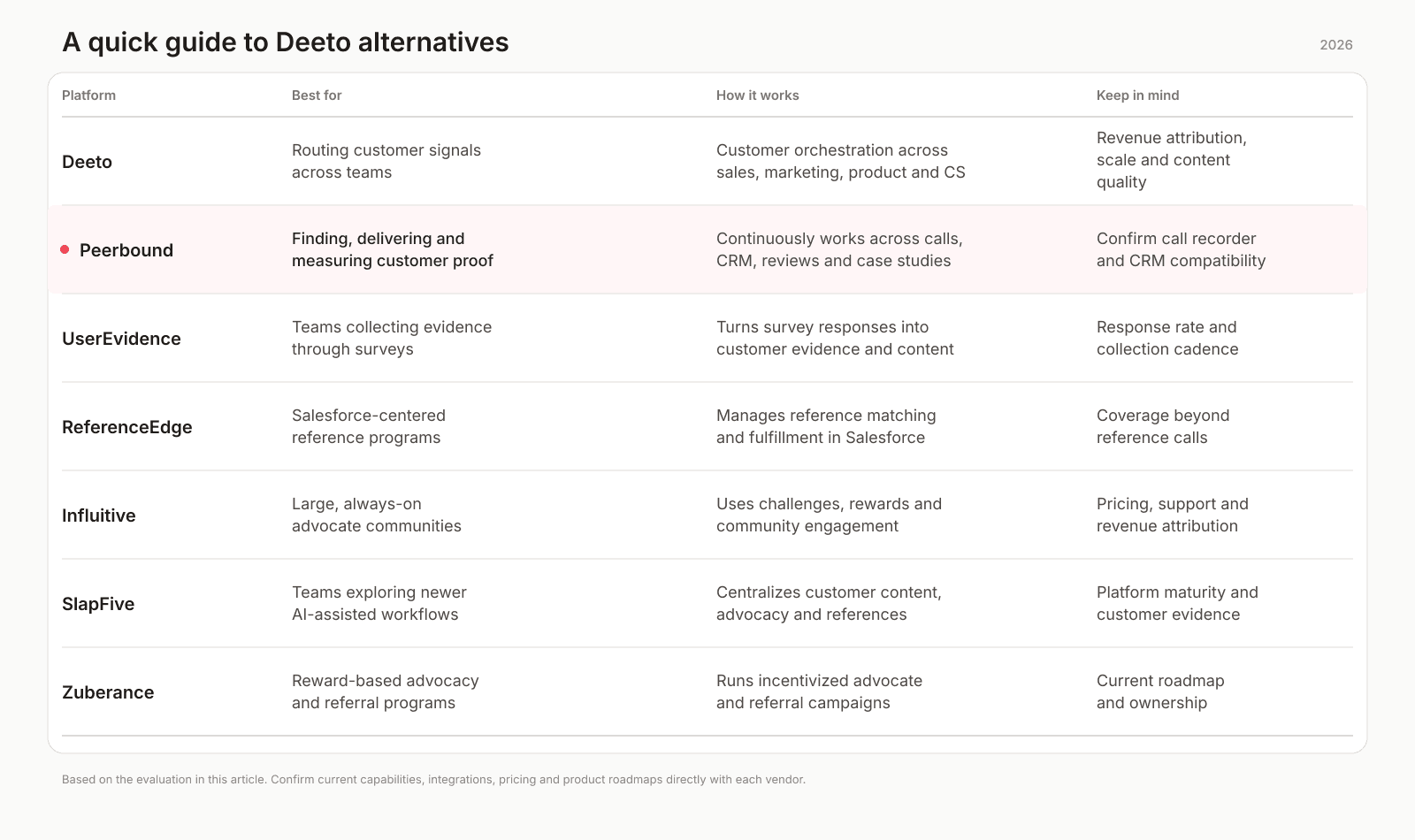
Peerbound is a customer proof platform, not a customer orchestration platform, and the difference isn't branding. Peerbound's Find agent listens continuously across your calls, CRM, and reviews and finds advocates, quotes, and competitive insight without anyone having to ask for it. And with support for 11 call recordings and counting, Peerbound is able to support a wider array of tech stacks than Deeto, which supports call analysis from fewer solutions.
Peerbound's Deliver gets customer proof to reps two ways: pushed to them automatically after a call, matched to the exact doubt the prospect raised, or pulled on demand through Slack, Teams, or the AI tools they already work in with the Peerbound MCP. Peerbound Measure ties every one of those touchpoints back to Salesforce, so you can see which stories showed up in deals that closed and which reps consistently use what you built, instead of reporting downloads and hoping they mean something.
Clari (a verified Peerbound customer) is the clearest version of what that looks like end to end. "I was essentially a human Slackbot," said Chris Dalton, former Director of Customer Marketing at Clari, describing his role before onboarding Peerbound. After building a proof system with Peerbound, 100% of new business opportunities at Clari are now influenced by customer proof, and the platform delivered measurable value in under a week of being connected. AlphaSense (a verified Peerbound customer) had a quote approved for press within five days of rollout and now gets quotes approved in under two hours, up from a workflow that used to run through scattered spreadsheets and CMS folders. Tipalti (a verified Peerbound customer) cut its case study production time from two months to two weeks and now publishes 2.5 times as many stories a quarter.
2. UserEvidence: the right call if you have no call recording tool yet
UserEvidence is a legitimate alternative if your team doesn't have a call recording solution in place and you're building a proof program from zero. It works primarily through surveys, which means it's a real option if you're comfortable collecting evidence from customers who opt in to answer, rather than mining proof out of conversations that are already happening. The tradeoff is what that structure implies: your proof pool is limited to who responds, and it updates on the cadence you send surveys, not continuously.
3. ReferenceEdge: a strong choice if reference calls are your only challenge
ReferenceEdge is Salesforce-native, holds a 4.6 out of 5 rating across 48 G2 reviews, and reviewers consistently praise its support team and how much time it saves finding a reference, "minutes instead of days" by one account. If your program is almost entirely reference-call management inside Salesforce, it's a real fit. But it's built for one of your five jobs. Several reviewers also describe the interface as dated and report recurring bugs, and it doesn't touch case study creation, G2 review generation, advocate discovery, or impact attribution the way a broader proof platform does.
4. Influitive: built for always-on advocate communities
Influitive runs a gamified community hub where customers complete challenges for points and rewards, and its TrustRadius reviews average 8 out of 10 across 207 responses. It's a real option if your program's core need is a large, ongoing engagement community rather than a proof pipeline feeding sales. Since JigSaw acquired the platform, several reviewers have flagged price increases and slower support, worth confirming directly before you go further.
5. SlapFive: a promising AI approach with a thin track record so far
SlapFive centralizes customer content, advocacy, and reference management, with newer agentic AI features aimed at automating more of the workflow. Its public review base is still small, two reviews on G2 at this writing, so there isn't yet a large sample to judge it against.
6. Zuberance: check who owns it before you build on it
Zuberance still runs a reward-based advocate marketing platform, but the company was acquired by IZEA, an influencer marketing company, in 2023. That doesn't mean the product is abandoned, but its roadmap now sits inside a different company's priorities than the ones building purpose-built B2B customer marketing tools. Worth a direct conversation about where it's headed before you commit a program to it.
How to choose the platform built for the job in front of you
Skip the category name and ask what it does with the five jobs on your desk. Can it tie a specific story to a specific closed deal, or only tell you it was downloaded? Does it keep working when your program expands past one region and one language? Does the content it generates come out ready to show a customer, or ready for you to rewrite? A platform that answers all three without you doing the work around it is a customer proof platform. One that answers none of them, no matter how broad its category name sounds, is asking you to keep doing the job it was supposed to take off your plate.
Frequently asked questions
What's the actual difference between Deeto and Peerbound?
Deeto is a customer orchestration platform: it captures customer voice and routes it into sales, marketing, product, and CS workflows. Peerbound is a customer proof platform: it continuously finds proof across calls, CRM, and reviews, creates polished stories and quotes from it, delivers that proof to reps automatically or on demand, and measures which of it actually closed deals. Orchestration is infrastructure between teams, while customer proof is the specific asset, the quote, the case study, the stat, that a rep puts in front of a buyer.
What's the difference between a customer orchestration platform and a customer proof platform?
An orchestration platform routes customer signal between internal teams: sales hears one thing, product hears another, CS sees a third. A customer proof platform is accountable for a narrower, more concrete output: does the sales team have the specific evidence it needs for the deal in front of it right now, a quote, a case study, a G2 review, a reference, and can you prove that evidence moved the deal.
Is UserEvidence a good alternative to Deeto?
Yes, specifically for teams that don't yet have a call recording tool in place and are building a proof program from scratch. UserEvidence works primarily through surveys, so it's a fit if you're comfortable with proof coming from customers who choose to respond rather than being mined automatically out of calls, CRM notes, and reviews you already have.
How long does it take to see value from a customer proof platform?
It depends on how fast the platform connects to the systems where proof already lives. Once Peerbound was connected to Clari's call recording tool, the team had usable proof within a week and access to moments from past calls within a day of the integration going live.
Which of these tools works best if I need to stay entirely inside Salesforce?
ReferenceEdge is the most Salesforce-native option on this list and is built specifically around reference call workflows inside it. Peerbound also integrates directly with Salesforce, but it operates across more channels, Slack, Teams, your website, and the AI tools your reps already use, rather than living entirely inside the CRM.
Publish the case study, run the CAB, get the G2 review, fill the reference request, book the advocate: the five jobs on your desk didn't change because you bought a platform named for something bigger. Peerbound is built to be accountable to exactly those five things, and to show you, in the same system, which ones moved a deal.
Book a demo to see how it works with the proof you already have sitting in your calls, CRM, and reviews.
Compare six Deeto alternatives for customer proof, advocacy, references, and sales enablement, including Peerbound, UserEvidence, and Influitive.