Key takeaways
Reps use customer proof when it takes no extra effort. Put it in Slack or Teams, in their inbox after every call, and inside the AI assistant they already draft with. Make it impossible to ignore.
Sales enablement is your best partner for this. Together, you can analyze behavior trends to learn why some reps use proof daily, and why others never touch it, then work together to fix what’s holding them back.
The win-rate lift gets leadership's attention. Gainsight (a verified Peerbound customer) sees a 2.5x increase in win rate on new business deals that use proof versus deals that don't.
Customer marketing becomes strategic when it can tie proof to revenue. Lattice (a verified Peerbound customer) has attributed almost $13 million in deal value and closed-won ARR to customer proof used in deals.
You've built the case studies, cleared the quotes, and put everything in one place. You know deals with customer proof close more often, and yet the follow-up your AE sent after this morning's discovery call still doesn't mention a single customer.
Sales won't go looking for proof on their own, and you don't have the hours to keep chasing reps down to remind them it exists. So how do you make using customer proof something reps do without being asked?
Reps make customer proof a habit when using it takes no extra effort. That means delivering proof inside the tools they already work in every day (Slack or Teams, their inbox after every call, and the AI assistant they draft with) and partnering with sales enablement to learn why some reps use proof daily, while others don't.
Customer proof is validation from a real customer, like a case study, a quote, a review, or a result, that gives a buyer a reason to believe you'll deliver what you promise.
Getting customer proof into deals is also how customer marketing becomes a strategic function: a team that can show which proof moved which deal gets a different kind of attention from leadership than a team that reports how many case studies they produced.
Why don't sales reps use customer proof on their own?
Sales reps skip customer proof when finding the right story takes more effort than the moment allows, and most customer marketers have experienced some version of this. Michael Burton, CEO of Stitch (a verified Peerbound customer), described his team spending money and hours on quotes and polished PDFs, celebrating the day each one went live, and then finding that "seven days later those assets are rotting in a Google Drive folder no one can find."
A story no one can find never makes it into a deal: "The value of customer stories is 100 percent correlated to access," says Burton. And for most sales teams, access breaks down in a few predictable ways.
The library exists somewhere reps don't go. An AE spends the day in Slack, email, the CRM, and increasingly an AI assistant. A proof library in a separate tool is another platform to learn, plus a new tab and login every time they search, so reps end up skipping it between calls.
Asking marketing takes longer than the moment lasts. Proof matters most right after a prospect raises a concern, and that window closes as soon as the next call starts. A DM to the customer marketer might get an answer in an hour or in a day, and by then the follow-up is already sent.
Even reps who open the library can't find the story that fits. Libraries are usually sorted one way at a time, like by industry or company size. A rep can pull up healthcare customers or enterprise customers, but an enterprise healthcare customer in Europe is a much more specific search than most libraries are built to answer.
What do reps who use customer proof every day do differently?
Some reps on your team might already use customer proof in almost every deal. The fastest way to spread the habit is to find out what they do and why, and sales enablement is the partner for that work. Enablement owns onboarding, coaching, and the tools reps are expected to use, so they see rep behavior you can't.
Chris Dalton, Principal, Customer Marketing at Gainsight, made the case with one number. He shared with leadership that across all new business deals, Gainsight sees a 2.5x increase in win rate on deals that use proof versus those that don't.
"There are very few other tactics a sales rep can easily implement to increase their win rates by over 2x," Dalton said. That metric started half a dozen conversations with people across the business who weren't using proof and wanted the same results, and it deepened Gainsight's partnership with sales and sales enablement.
Here's how to run the same diagnosis with your enablement team:
1. Split win rate by deals with and without proof
Pull closed deals from the last two quarters and sort them by whether customer proof showed up anywhere in the deal, like a follow-up email, a deck, or a business case. Compare win rate and deal size. You can use a tool like Peeround Measure to do this, but if you can't track proof usage automatically yet, a manual sample of closed-won and closed-lost deals is enough to start the conversation.
2. Talk to both groups of reps
Interview a few reps who use proof constantly and a few who rarely do. Ask each one about the last time they needed a customer story. Where were they? What did they do next? How long did it take to get what they needed? Listen for where and when as closely as you listen for what, because those two answers tell you where proof has to show up.
3. Map where proof moves a deal
Sit down with enablement and walk a deal from first email to signed contract. At every stage, ask what the buyer needs to believe to move forward and which proof gets them there.
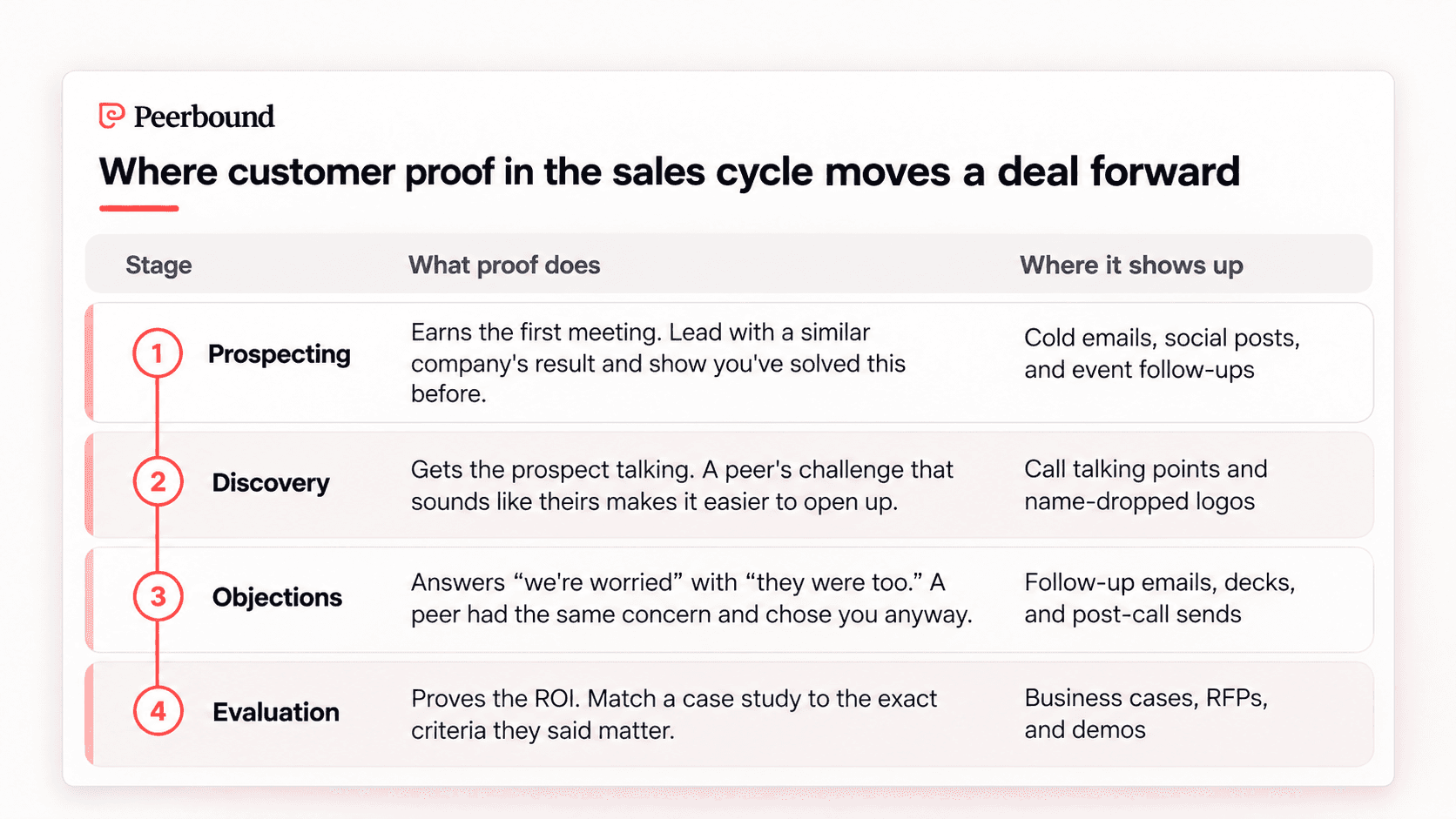
At any stage, a relevant case study is an easy way to add value without asking for anything back.
4. Deliver proof inside the tools reps use at each stage
The last column of the table shows where reps need proof: cold emails get written in the inbox, objections come up on calls and get answered in the follow-up, and business cases are increasingly drafted with an AI assistant. Proof has to show up in those tools, because reps won't leave them to go find it.
How do you put customer proof where reps already work?
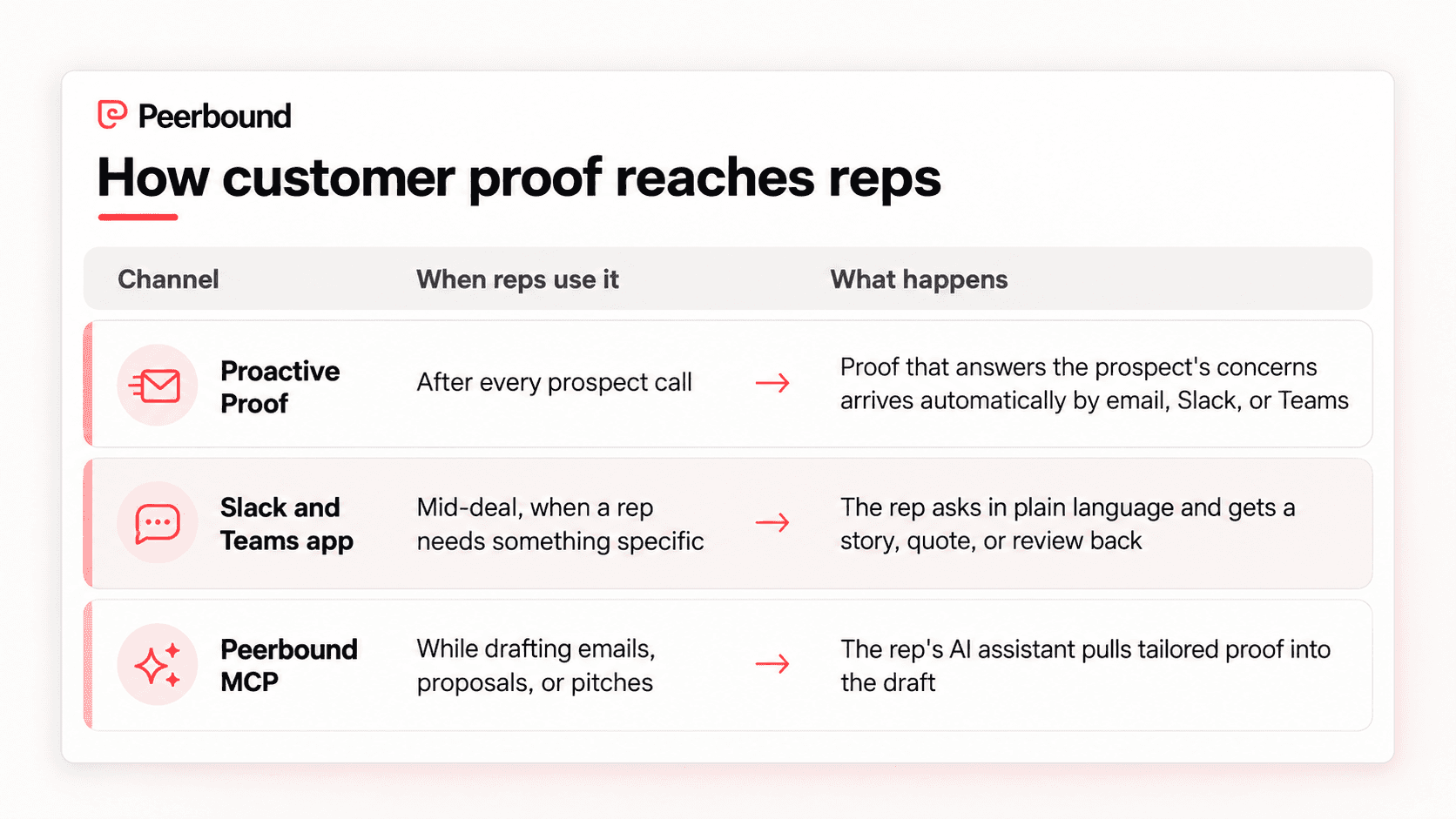
Peerbound delivers customer proof into the three places reps already spend their day, and each one matches a different moment in a deal.
After the call, the proof is already in the inbox
After every prospect call a rep has, the proof they need is already waiting in their inbox. Proactive Proof sends the customer stories, quotes, and reviews that answer the exact concerns the prospect just raised, so every objection comes with a peer who had the same worry and signed anyway.
Each quote is labeled as something customers said publicly or privately, and reps can copy quotes straight into their follow-up email.
At Lattice, these emails see almost 70% open rates across the sales team. "Some reps say they can't live without it," said Kerry Wheeler, Director, Product Marketing at Lattice.
At Motive (a verified Peerbound customer), the emails reached the CMO. Liza McGraw, Senior Customer Marketing Manager at Motive, showed him the feature, and he called it "a strong example of how we're shifting from enablement to 'education that seeks the user, meeting sellers where they are, with what they need, in real time."
Mid-deal, reps ask for proof in Slack or Teams
A rep types "healthcare customer who switched from a competitor" into Slack or Teams and gets the story, quote, or review back in less than a minute. There's no new login and no waiting on anyone.
At Gainsight, sales "closes deals faster with on-demand customer validation via Slack and proactive post-call emails," said Melanie Paddock, Former Senior Manager, Customer Marketing & Advocacy at Gainsight.
While they write, the AI assistant works with your customer intelligence
More reps now draft follow-ups, proposals, and pitches with an AI assistant. The Peerbound MCP connects that assistant, whether it's Claude, ChatGPT, Glean, Gemini, or another tool, to your customer proof. MCP stands for Model Context Protocol, a standard way to connect AI assistants to outside data. A rep can ask for "fintech, 1,000+ employees, switched from a competitor" and get the right case study, quote, or review in one answer, inside the draft they're already writing. It follows the same approval and anonymity controls as the rest of your proof.
Kevin Joshi, Sales Enablement Manager at Virtru (a verified Peerbound customer), uses Proactive Proof recaps to write his own follow-ups. "Those recap emails are really helpful for formulating and personalizing my follow-up emails to customers. I don't have to think about it as hard," he said. Others at Virtru are following his lead, pasting the recap into their AI tool, connecting it to their Salesforce MCP, and having it write the most relevant follow-up.
At Gainsight, Dalton said one of his reps is planning to "build Peerbound MCP into every call prep skill, whether intro, discovery, or workshops, so MCP is part of building out decks or meeting prep." Another Peerbound customer has received “really positive feedback from sales about the MCP," and after one rep shared that it was saving them a lot of time, more people reached out asking how to get access.
What customer proof does each seat on the sales team need?
Every seat on the sales team uses customer proof at different moments and for different buyers. Here's what each role needs from you.
SDRs book more first meetings
Prospects are more likely to reply when a cold email shows a company like theirs already got results.
Prospect research. SDRs find the customer story that matches a prospect before they write a word.
Personalized emails. An industry-specific quote goes into every cold email.
Early brush-offs. "Not interested" or "too expensive" gets answered with a peer who said the same thing.
Event follow-up. Every attendee gets matched with a customer story that fits their profile.
AEs bring a happy customer to every conversation
A story from a similar customer helps in discovery, the demo, and the business case.
Discovery prep. AEs walk in knowing the challenges similar customers faced and how they solved those challenges.
Competitive deals. They pull stories from customers who chose you over the competitor.
Cost and timing concerns. Real customer quotes answer worries about cost, complexity, resources, and timing.
Business cases. ROI numbers come from comparable companies.
Enterprise deal team win over every stakeholder in the room
Enterprise deals need proof for IT, security, legal, and the board.
Stakeholder mapping. Each stakeholder gets targeted proof, whether they sit in IT, security, compliance, legal, or the business.
Security reviews. SEs find customers who cleared the same standards and compliance frameworks.
Executive presentations. C-level peer testimonials and enterprise ROI stories go into committee reviews.
Competitive bakeoffs. Wins against specific competitors in enterprise environments show the buyer who else made the same call.
How does customer marketing show that proof is working?
Lattice has attributed almost $13 million in deal value and closed-won ARR to customer proof its team uncovered and used in deals. A number like that changes the conversation customer marketing has with leadership.
Most customer marketing leadership reports count output, like case studies published or quotes approved. A report that puts win rate on deals with proof next to win rate on deals without it answers the first question leadership asks: did your work move revenue? Dalton's 2.5x number did that at Gainsight, and it's why teams across the business started asking how to get the same results.
Peerbound's Measure agent tracks every time customer proof shows up in a rep's email or on a prospect call and ties it to Salesforce, so you can see which proof appeared in closed deals and how win rate changed when proof was in the conversation.
The same data helps sales enablement coach reps, since it shows which reps use proof and which don't. And once sales leaders see that reps who use proof win more deals, they start pushing the rest of the team to use it too, so customer marketing isn't the only one asking.
What still gets in the way?
Delivery puts proof in front of reps, but it doesn't guarantee they'll use it. Lattice's almost 70% open rate is strong, but it still means some reps aren't opening the email. Those reps need coaching from enablement and their managers, and ideally a peer on the team who can show them how proof helped close a real deal.
Even reps who open every email will eventually ask for proof the library can't answer. When they keep asking for healthcare proof, and there isn't any, that's a signal telling you exactly which quote to capture or story to create next.
And once that quote exists, it still needs approval. A quote that hasn't been cleared for public use can shape a rep's pitch but can't go into a cold email with the customer's name attached, so how much public proof reps can use depends on how fast your approval process moves.
Coaching, missing stories, and slow approvals are the reasons reps still have to skip proof, and customer marketing can fix every one of them. Dalton is building this habit for his team at Gainisght, after doing it first at Clari (a verified Peerbound customer). His goal is "to make it so easy to use customer proof in every prospect interaction that there is no reason not to do it."
Start with the reps who already use proof, find out where they were when they needed it, and put the next story there. The next follow-up your Sales team sends shouldn't go out without a customer in it.
See how Peerbound delivers customer proof to every rep.
Frequently asked questions
How do I get sales to use my customer proof? Make customer proof available in the tools reps already use, at the moment they need it. That means Slack or Teams for on-demand requests, the inbox after every prospect call, and the AI assistant reps draft with. Partner with sales enablement to find out why some reps use proof daily, and others don't.
How can marketing help sales close more enterprise deals? Marketing helps close enterprise deals by giving every stakeholder proof from a peer they trust. IT and security want customers who cleared the same standards, executives want C-level peers and ROI from comparable companies, and buying committees want wins against the competitor in the deal. Gainsight sees a 2.5x increase in win rate on new business deals that use customer proof.
What is Proactive Proof? Proactive Proof is a Peerbound feature that sends reps customer proof automatically after every prospect call. It finds the concerns the prospect raised and delivers matching stories, quotes, and reviews by email, Slack, or Teams, with each quote labeled as something the customer said publicly or privately. Lattice sees almost 70% open rates on these emails across its sales team.
How does the Peerbound Slack and Teams app work? The Peerbound Slack and Teams app lets anyone at your company ask for customer proof in plain language and get it back in 30 seconds. Reps can ask for a similar customer, an industry, a competitor switch, or a case study without learning a new tool or waiting on customer marketing.
What is the Peerbound MCP, and how is it different from Peerbound for Web? The Peerbound MCP connects your team's AI assistants, like Claude, ChatGPT, or Gemini, to your customer proof so reps can pull tailored proof into emails and proposals as they write. It's internal and serves only your own team. Peerbound for Web is public and puts approved proof on your website and on a page AI search tools can index, so it reaches buyers researching you.
Sales uses customer proof when it shows up in Slack, their inbox, and their AI assistant. How Gainsight, Lattice, and Motive made proof part of every deal.