It's 4 p.m. on a Wednesday, and an account executive named Charlotte has a call with an AI-native healthcare prospect in twenty minutes. She doesn't have a case study for that vertical memorized. She doesn't know if anyone on the team has already talked to a company like this one. So she opens Slack, types a question to the customer proof bot, and has an answer before her coffee goes cold.
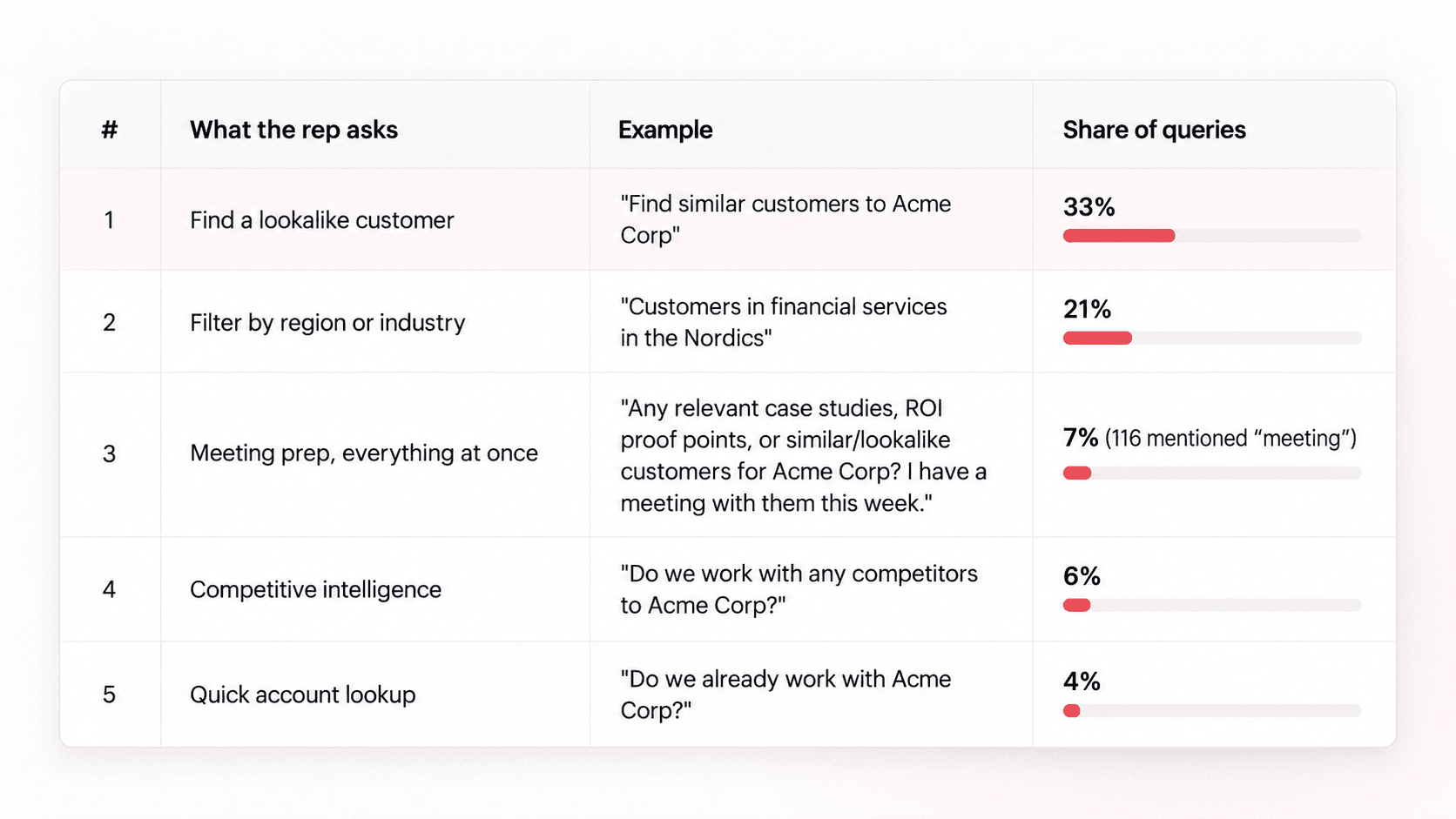
Multiply that moment by however many reps are selling on any given afternoon, and a pattern shows up. Customer proof, the quotes, reviews, and case studies that show a product working for someone like the buyer in the room, is what Charlotte needed. Over the past six months, Peerbound's Slack and Teams apps fielded 1,859 real queries from sales teams asking for exactly that. Those requests for customer proof fall into five question types, and one of them comes up far more than the rest. Reps overwhelmingly want a lookalike, an existing customer who looks similar enough to the prospect in front of them to make the pitch feel less risky.
Here's what each category actually looks like, and what it should tell a customer marketing team about where to spend the next quarter.
1. "Find me customers like this prospect"
A rep pastes a company name or a URL and asks for existing customers that resemble the prospect. It's the question reps reach for before they've even finished reading the discovery notes, because it's the fastest way to make an unfamiliar deal feel familiar.
At Clari (a verified Peerbound customer), this pattern shows up directly in the numbers. Peerbound's Slack app cut the company's customer marketing workload by roughly 20 to 40 hours a month, freeing up time that used to go to manually tracking down a comparable logo every time sellers couldn’t quickly identify one themselves. Chris Dalton, former Director of Customer Marketing at Clari, described what that shift felt like while he was there. "Peerbound's AI agents fetch the perfect proof from different sources and deliver it to every AE right when they need it. Our reps don't need to search anymore. With Peerbound, customer proof finds the rep, not the other way around."
This has less to do with writing new case studies and more to do with tagging the ones already sitting in the library, by industry, size, and use case, well enough that a rep can find their nearest match in seconds via a natural language search instead of scrolling through a folder of sales enablement platform.
2. "Show me in this region or industry"
Reps request filtered lists too, sorted by geography ("customers in APAC," "customers in Texas") or by vertical ("cross-border M&A advisory and investment banking"). This is also a segmentation problem more than a content problem. The proof usually already exists somewhere, likely in a Highspot library or on your website. The question is whether it's been tagged in a way that a filtered search can actually find. Importantly, natural language queries can allow reps to not be stuck if a predetermined filter does not match what they are looking for. If a rep is visiting a hub city for a pitch or conference and wants to invite customers in the area, for example, then a fixed filter would leave out many customers in surrounding cities that can be strong candidates for the event. It’s also unlikely that your case study library is filterably by city, or even country. That data likely lives in your CRM, and doesn’t connect back to your case studies automatically.
This is where self-serve access in natural language changes who does the filtering. At Tipalti (a verified Peerbound customer), Peerbound's Slack-based retrieval gave both marketers and reps 100% self-serve access to approved proof. Nobody on the team has to interrupt a customer marketer to ask what exists in a given segment. They ask the Peerbound Slack app instead, and it returns exactly the customers they asked for in less than a minute.
3. "Help me prep for this meeting"
"I have a meeting with this prospect this week, what do we have?" is a more in-depth kind of request, and requires search functionality that a sales enablement platform simply can’t support. Reps batch everything into one query before a call, asking for case studies, ROI numbers, similar customers, and competitive context all at once. These tend to be the longest, most detailed asks in the data, because the rep isn't looking for one thing. They're building a small dossier as they customize their pitch for the impending prospect demo.
Kerry Wheeler, Director of Product Marketing at Lattice (a verified Peerbound customer), described what changes once that dossier-building stops getting bottlenecked by one person. "Peerbound has given us freedom and space," she said. "We no longer waste days answering questions in Slack, and our company can now self-serve to access proof on their own. There's no middleman, and we've democratized customer proof across the company."
Meeting-prep queries done in a modern, automated way allow a rep to get everything they need for a specific conversation, while Customer Marketing never has to be the one assembling it.
4. "Tell me which competitors do we work with"
"Do we work with any competitors of this prospect?" shows up often enough to be its own category. Reps ask to check whether they already have a customer operating in the same space as the deal in front of the rep, because a competitor's peer using your product is some of the strongest social proof available in a live conversation.
Michael Burton, Co-Founder and CEO of Stitch (a verified Peerbound customer), wrote about what this kind of access did to his team's habits once it existed. Before Peerbound, he described creation as easy and activation as impossible. Proof sat in a Google Drive folder nobody could find a week after launch. After, in his words, "every Stitcher can summon our entire proof library with a single chat prompt," asking things like which stories cover a specific technical solution or which wins involve a specific partner combination, and getting an answer instantly, linked to the source. Stitch went further and opened a Slack channel so their partner Braze could query the same library, turning a vendor relationship into something closer to a shared reference desk.
5. "Tell me our customers"
"Do we already work with this company?" is the simplest request in the data, and often the first thing a rep checks before going any deeper. It's a yes-or-no question standing in for a much bigger one. Is there already a relationship here to build on? A rep can already pull that yes or no from Salesforce. What Salesforce won't hand back is the quote, story, or detail that turns a confirmed account into something usable mid-conversation, and getting that still usually means pinging a customer marketer. Asking the bot instead returns the confirmation and the proof together, in one message. It's also the easiest of the five categories to serve well, because unlike the other four, it needs no tagging and no new content. Just an accurate, current account list a rep can query in plain language.
One App in Slack and Teams Covers All Five Questions Nearly Instantly
Across a deal, these five categories cover most of what a rep asks for, from a lookalike at the start of a deal to a quick confirmation right before a meeting.
Account lookups and lookalike requests tend to come earliest, often before a first call. Meeting prep spikes right before any high-stakes conversation, whether that's discovery or a demo. Competitive intel tends to show up later, once a prospect names a rival mid-cycle. That same lookalike matching shows up again at the very end of a deal, when a rep needs a customer willing to do a reference call. Each stage of a deal calls for a different kind of proof.
Peerbound's Slack and Teams app answers all five the same way, within seconds. A rep asks a plain-language question in the tool they already have open, and the app matches the prospect to the closest existing customer, then returns the story, quote, or review that proves it, pulled from call recordings, the CRM, and G2 reviews. There's no new login, no ticket routed to a customer marketer, and no waiting for someone else's afternoon to open up.
Every answer it returns has already been through the same approval workflow customer marketers use for everything else. A rep asking for a lookalike at 9 p.m. gets back a story that's already been signed off on, significantly quicker than it would have if a person had sent it by hand.
Self-serve access pays back in hours saved and in requests that never reach a customer marketer's inbox at all.
Peerbound understands and organizes proof by industry, size, use case, product, user level, and more, so the app has something accurate to hand back every time one of these five questions comes in.
We wrote about the self-serve shift itself in "How to Give Sales Self-Serve Access to Customer Stories,” if you want the fuller argument for why getting proof in front of reps fast is what actually makes a proof program work. This piece is the data behind that argument.
Frequently Asked Questions
What questions do sales reps actually ask about customer proof? Across 1,859 real queries, five question types cover almost everything reps ask for. They want a lookalike customer for a specific prospect, proof filtered by region or industry, everything needed for an upcoming meeting bundled into one answer, a check for competitive overlap, and confirmation that a specific company is already a customer. The lookalike request is by far the most common of the five.
How does a Slack app for customer proof work? A rep types a plain-language request, similar customers, a case study, a quote, directly into Slack or Teams, and the app returns matching, approved customer proof pulled from call recordings, the CRM, and reviews. This happens within seconds, without any new login or ticket routed to a customer marketer.
How much time does self-serve customer proof save customer marketing teams? At Clari, self-serve Slack delivery cut customer marketing workload by roughly 20 to 40 hours a month. At Tipalti, it gave marketers, not just sales reps, 100% self-serve access to approved proof, removing an entire category of internal requests.
How do I know which customer proof to prioritize creating? Look at what reps already ask for most before creating anything new. The data above says to start with content that supports lookalike matching, industry and size tags on existing stories, since that's the request reps make more than any other. Meeting-prep bundles come next. New creation matters less than making sure what already exists can be found by the attributes reps actually search on.
An analysis of 1,859 real sales queries shows the five things reps ask for most, and what customer marketing teams should prioritize building next.