
It's 8:18 on a Thursday evening. Your laptop has been closed for hours. You're on the couch, half-watching something you won't remember tomorrow, when the Slack notification lights up your phone.
"Hey, do we have a customer that looks like ABCDE I can send a prospect? Call's at 9 tomorrow."
You don't know the deal. You don't know the prospect. But you know you have something, somewhere, that would work. So you pull the laptop back open, dig through the CMS, find a quote, check whether it's approved, and fire it back at 8:40. The rep sends a thumbs up. You close the laptop for the second time tonight.
That DM is going to land again tomorrow. From someone else. About a different deal.
None of this means your reps are lazy or your content library failed. Both are doing their jobs. The catch is that the one resource that scales worst, you, is the one everything routes through. If you want sales to use customer proof at the speed deals actually move, they need to find it themselves, from a source they trust, the moment they need it. That problem is fixable, and you don't fix it by answering faster.
A seller needs customer proof at almost every hour. They find it at almost none.
Spend a day inside the calendar of an enterprise account executive. Call him Andreas.
He starts at 8 reading overnight replies, security questions, and the one deal that's gone silent. By 9 he's defending his forecast in pipeline review. At 9:30 he's running discovery on a new account, mapping the buying committee, the budget, the timeline. By 11 he's leading the commercial half of a demo while a solutions consultant drives the product, tying every feature back to a pain the buyer named out loud.
After a lunch he eats while approving a proposal, he's strategizing a stuck deal with his manager, then walking into a 1 PM workshop with IT, finance, and an executive sponsor who has questions he didn't prep for. The afternoon is quote-building, discount approvals, procurement, legal, and security review, the part of selling that is really just project management with a quota attached. At 4 he finally has a window for follow-up, the moment he needs a case study, an ROI stat, or a reference customer that answers the exact objection from this morning's call. At 5 he sets up tomorrow and does it again.
Count the moments customer proof would have helped: discovery, the demo, the executive workshop, the objection handling, the follow-up. Now count the moments Andreas had a free minute to go find it. The two numbers don't match, and they never will. Customer proof he has to stop and hunt for is customer proof he mostly does without. He believes in it. He just never has the ten minutes the hunt would cost him.
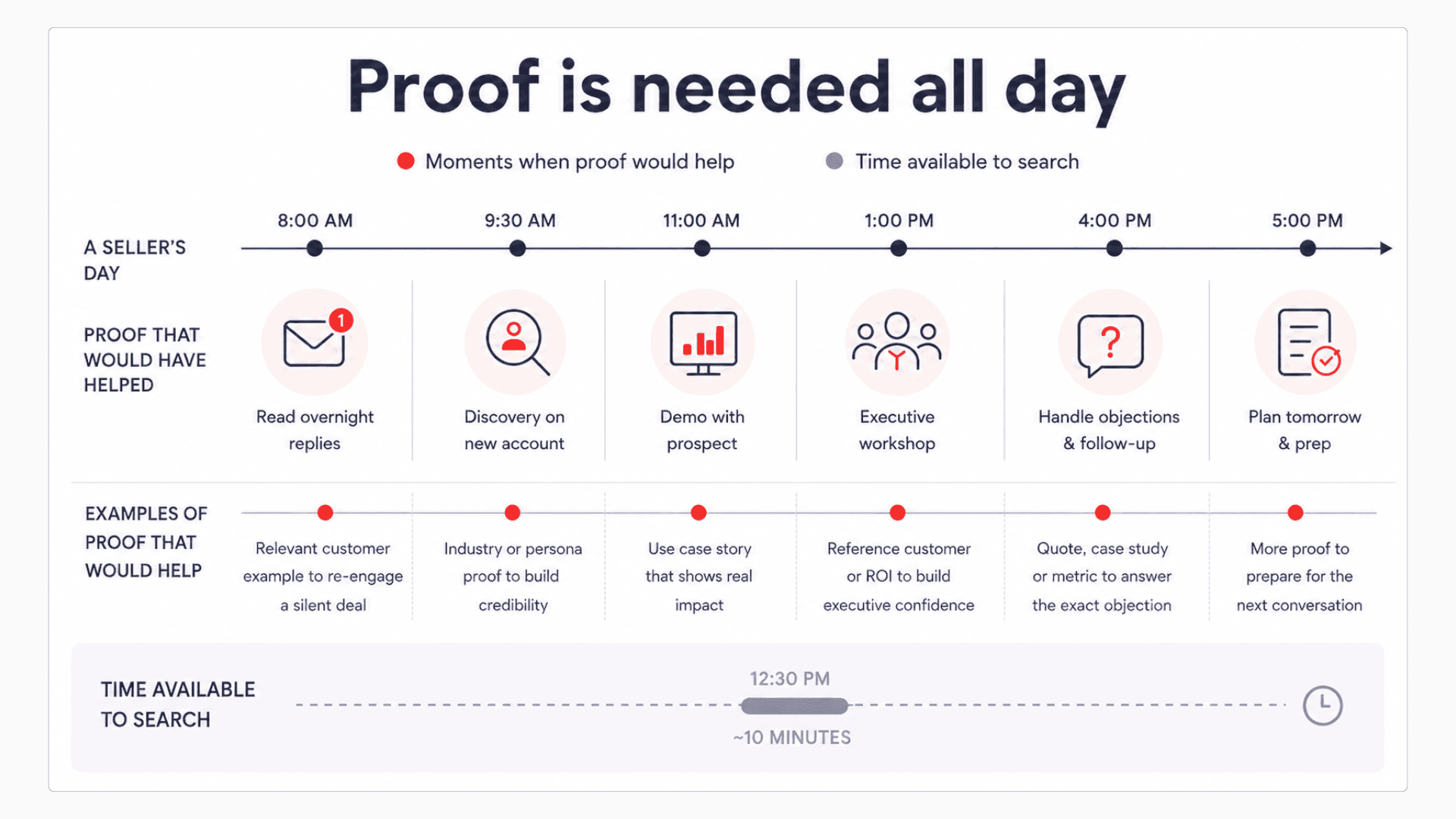
This is the tax on every customer proof program. You can produce the best case study of the quarter, and if it surfaces only when a rep remembers it exists and has ten minutes to search, most of its value evaporates before it reaches a buyer. As the Gainsight team put it in our panel on measuring customer marketing, "if sales can't find the right insight when they need it, it might as well not exist."
Stop being the search bar. Teach reps to fish.
The instinct, when the DMs pile up, is to get faster at answering them. Build a better folder structure. Pin the top assets. Send a monthly "here's what's new" digest and hope it sticks.
None of that changes the underlying shape of the problem, which is that customer proof flows through you. As long as a human is the search bar, customer proof moves at the speed of that human's inbox. Your best reps learn to work around it by building private stashes of their favorite quotes. Your newest reps, the ones ramping right now who need customer proof most, don't even know what to ask for.
So teach them to fish. When every rep can find approved, current customer proof on their own, the constant interruptions stop being the price of doing your job well. One customer marketer described the before-Peerbound state on G2 better than I could: "our lean team of two was getting DM'ed to inquire about case studies in X industries, quotes for Y company size, etc. The requests never ended, despite us having an internal hub to encompass most of these resources."
They had the hub. The DMs kept coming anyway. A hub is a place reps have to remember to visit. Peerbound puts customer proof where they already are. Self-serve access works only when two things are true at the same time: reps can reach customer proof inside the tools they already live in, and everything they find is something you'd be glad to put in front of a buyer.
Self-serve works only if the pond is stocked with approved, current customer proof
Teaching reps to fish does nothing if the pond is empty, or worse, full of customer proof that's stale or off-message. So the real work of self-serve is guaranteeing that the moment a rep grabs a quote at 9 PM, it's approved, accurate, and current. Access is the easy part.
This is what Peerbound is built for: moving customer proof to where reps already work and gating all of it on your approval. Peerbound's Slack and Teams app is the clearest version: anyone in the company can ask for a customer like the one in front of them and get an answer in seconds, with no new login and no ticket routed to you. The habit reps already have, asking for help, finally gets an answer that doesn't depend on whether you're awake. From there, customer proof can reach a rep before they even think to ask. After a call, the relevant logo, quote, or ROI stat can land in their inbox tied to the exact pain the prospect named, so the follow-up half-writes itself while the conversation is still warm. And for the reps who now run their day inside an AI assistant, the Peerbound MCP lets those tools query your proof collection directly: ask which existing customers look like a given prospect, or what proof to bring to a specific deal, and approved stories, quotes, and reviews come back.
The same collection reaches past your reps to the buyers researching you. Most of a buying decision gets made before anyone talks to sales, often with a prospect reading your site or asking an AI tool what you're like. Peerbound for AEO publishes your approved quotes, reviews, and stories straight to your website and keeps them current on its own, adding new proof as it's approved and dropping anything you remove. It can even generate a proof page built to be read by AI search, so when a prospect looks you up before the first call, your customer proof is part of what they find. The version a buyer turns up on their own matches the version a rep sends them.
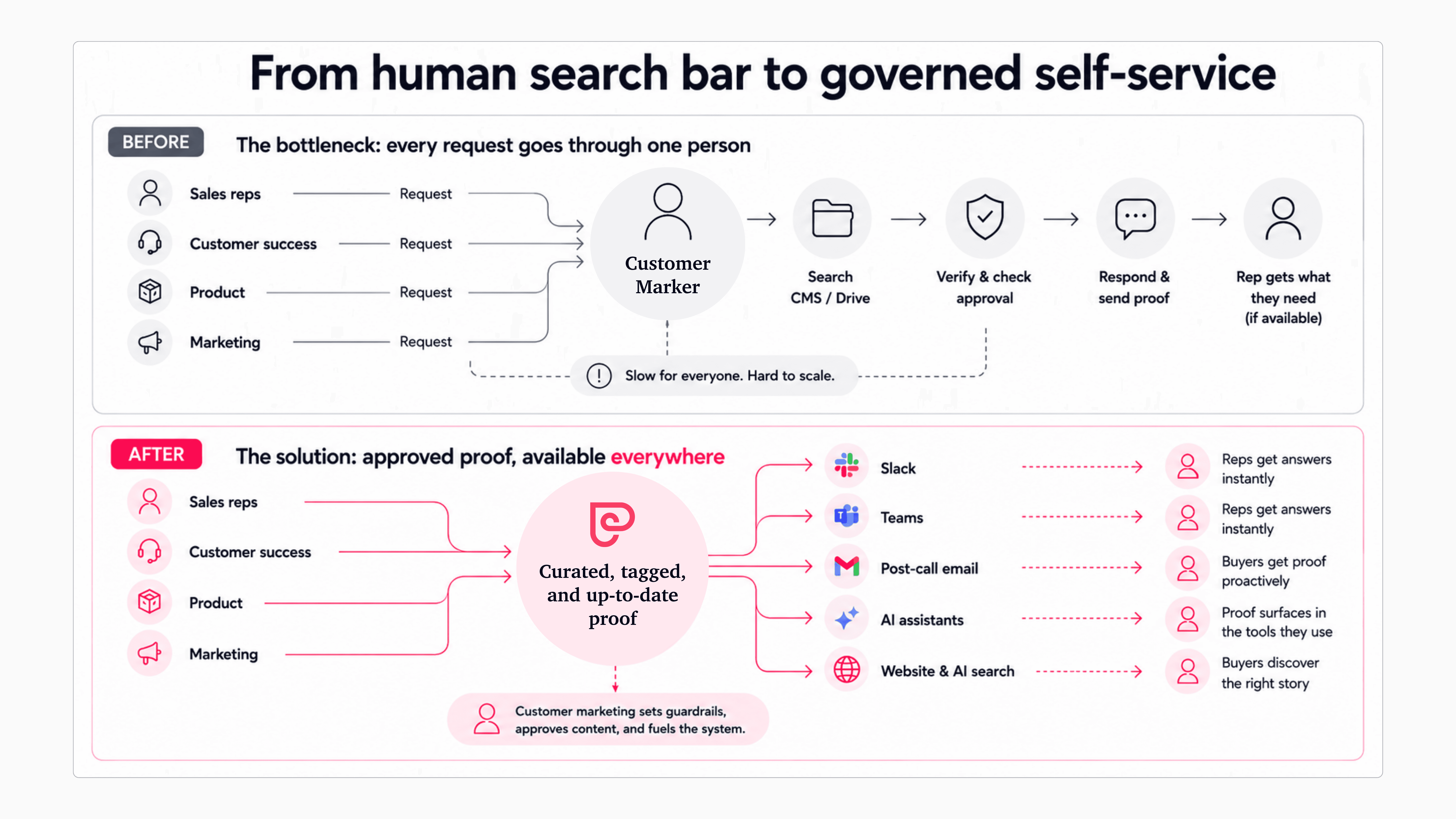
Look at what runs underneath all of it: nothing reaches a rep or a buyer until you've approved it. Speed and control stop competing. Reps move fast, you keep the final say over what's accurate and on-message, and the pond stays stocked with customer proof you'd stand behind.
When customer proof finds the rep, reps actually use it
Here's what changes when you stop being the search bar.
AlphaSense runs a 600-person revenue team, and before this shift their reps were stitching customer proof together from spreadsheets, website snippets, and content buried in the CMS. Brittnee Dawson, their Director of Customer Marketing, put customer proof into the tools reps already use with Peerbound and watched adoption move on its own. The opt-in Slack channel grew from 200 to 400 users on word of mouth alone. Engagement in that channel doubled in under a month. Reps received more than 5,000 proactive proof emails after their calls, and the number of reps actually using customer proof doubled in the first month after launch. Quotes that used to get lost in team transitions now get approved in under two hours. You can read the full AlphaSense story here.
The pattern repeats. At Gainsight, Melanie Paddock made customer intelligence self-serve through Peerbound in Slack, and the result was a channel reps live in: "That Slack channel is one of our most used Slack channels at Gainsight. Reps are in there every day saying, 'Show me case studies on X. Show me customers who look like X.'" That's the 8:18 DM, except no human had to answer it.
And from a customer marketer on G2: "Peerbound helps me be more proactive and efficient, whether capturing customer moments, generating stories, or improving collaboration. The Slack integration is great at surfacing proof for specific customer questions. One of the best parts is how it's brought cross-functional teams together. Seeing customer managers, sales reps, and even product managers sharing insights in Slack has been unexpectedly motivating for everyone, and the proactive proof emails are helping sales reps stay on top of their deals." (Thao Littler, Senior Customer Marketing Manager, Crunchtime.)
The throughline across all three is the same: customer proof stopped depending on one person's availability, so it started showing up in the deals that busy reps used to handle without it. A better filing system was never going to pull that off.
Give everyone the confidence to give buyers a reason to believe
You'll get your evenings back, too, but that's the side benefit. The real win is that your customer proof finally reaches the deals it was made for.
Frequently asked questions
How do I make customer stories easy for sales to find without creating another content library they won't use?
Put customer proof where reps already work instead of building a destination they have to remember to visit. A library only gets used by the reps who think to open it. When customer proof is searchable from Slack or Teams, and the most relevant story arrives in a rep's inbox right after a call, finding it becomes the path of least resistance rather than one more task they have to choose to do.
How can I give reps self-serve access while making sure they only share approved, up-to-date customer proof?
Gate everything on approval. The goal is a single source of customer proof where nothing becomes visible to reps until you've signed off, and where approved assets update everywhere at once when something changes. Then self-serve speed and message control stop competing: reps grab what they need in seconds, and everything they can reach is something you've already cleared. AlphaSense, for example, gets quotes approved in under two hours, so "approved and current" doesn't have to mean "slow."
How should customer stories be organized so sales can quickly find the right example by industry, use case, persona, or objection?
Organize around the question a rep is actually asking in a live deal. In the moment, a rep isn't picturing your manufacturing folder. They're thinking, "I need a customer who looks like this prospect and raised this objection." So tag and surface customer proof by the attributes that match a live deal: industry, company size, use case, persona, and the specific objection it answers. Then a rep can describe the prospect in front of them and get the closest match back. The teams seeing the most adoption let reps ask in plain language and let the system do the matching.
See it in a real program
AlphaSense gave a 600-person revenue team self-serve access to customer proof and doubled rep usage in a month, with quotes approved in under two hours. Read the full AlphaSense case study to see how they did it.
Sales reps need customer proof at every stage of a deal but rarely have time to find it. Here's how to make proof self-serve without becoming the human search bar.