Most of the AI conversation in customer marketing is still about content creation. First drafts, social copy, maybe a case study outline. That's table stakes now. The more interesting question is what happens when you point AI at your customer data and let it do things you genuinely couldn't do before.
In our recent live session, How I AI: Top AI Plays from Canva and Motive, Crystal Anderson, Customer Marketing & Advocacy Manager at Canva, and Liza McGraw, Senior Customer Marketing Manager at Motive, shared how they're using AI to build revenue dashboards, plan conferences from thousands of customer quotes, automate personalized outreach, and stand up an awards program in six weeks.
Here's what they shared.
How Liza McGraw Used AI to Turn 3,000 Customer Quotes Into a Conference Agenda
Motive is an AI-powered operations platform that unifies safety, asset tracking, compliance, and spend management for companies with physical fleets. Trucking, transportation, field services, oil and gas. Liza runs customer marketing there as a team of one, serving over 100,000 customers.
She was deep in planning for Motive's annual customer conference, Vision 26, when product marketing asked her to pitch ideas for 30 breakout sessions. The typical approach would be to lean on the 50 or so existing customer stories and brainstorm from there. Liza went a different direction.
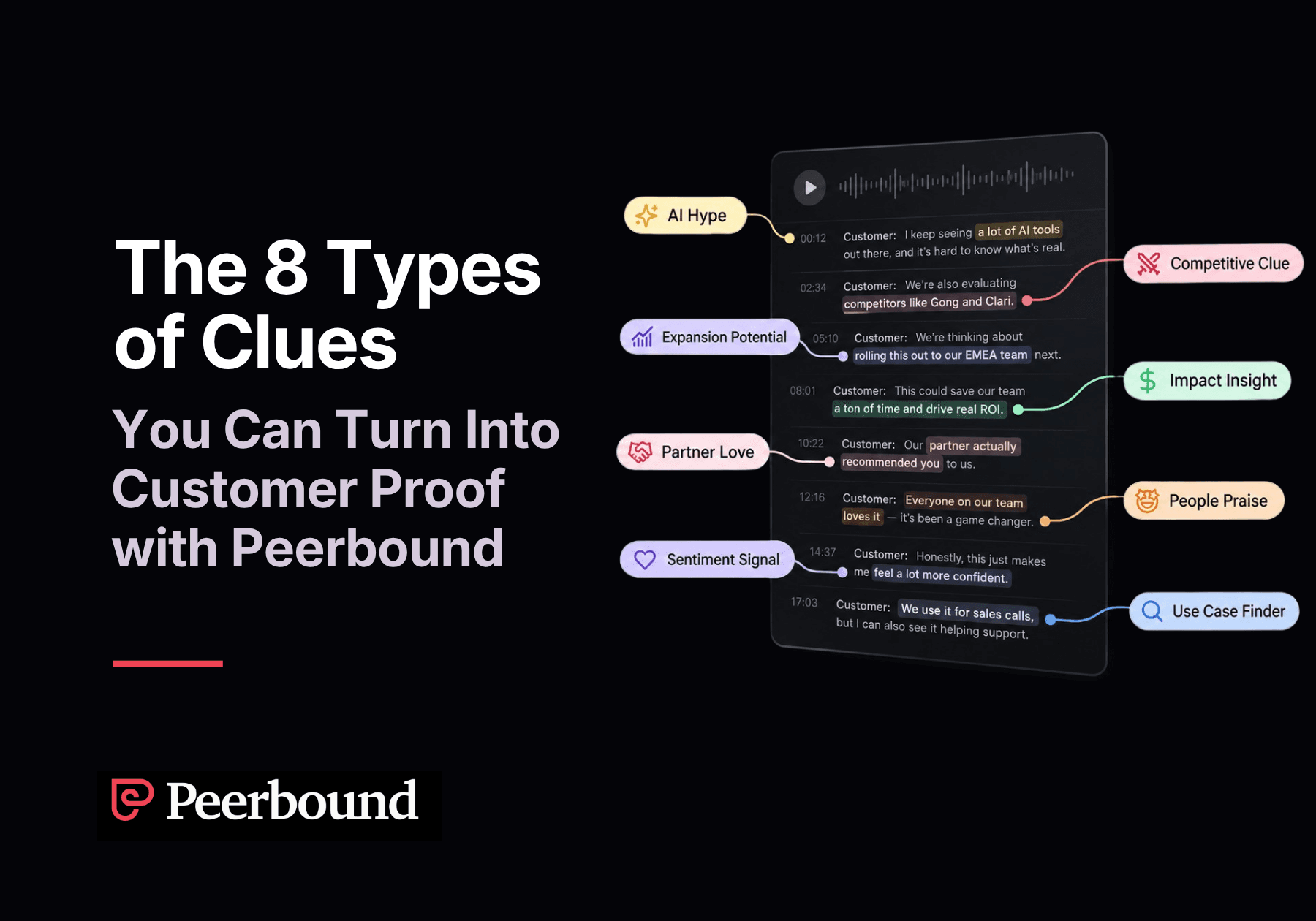
She exported 3,000 customer Moments from Peerbound into a spreadsheet. Customer Moments are real quotes from recorded customer conversations, each automatically tagged by theme (AI hype, sentiment signal, competitive clue, impact insight, and more). She filtered for Moments where customers talked about new use cases, innovation, positive sentiment, and AI capabilities, then dropped the full spreadsheet into ChatGPT with a clear prompt: “organize these into eight session themes for our annual customer conference, and recommend three to five customers per session based on their own words.”
The result was a conference agenda grounded in what customers were actually saying, not what the marketing team assumed they cared about. Several sessions made the final lineup. Speakers were sourced directly from the export.
"It included 3,000 customer inputs. This was not based off of the 50 customer stories we have."
That same workflow spread across the organization. Motive's content team started using Moments to create blog content for specific fleet segments. Rather than finding a customer and then writing about their topic, they find the quote first and build the story around it. The only outreach left is asking the customer to be featured.
The product and research teams also adopted the workflow. Liza described reading the Peerbound Moments channel as her morning news: a daily briefing on what customers are actually talking about that week.
How AI Helped Build a Customer Awards Program in Six Weeks
Liza's second project landed on shorter notice. She was given six weeks to build Motive's first customer awards program from scratch, on top of everything else she was delivering for the conference.
She used Claude to turn a single 30-minute planning call into a full execution one-pager: deliverables, dependencies, stakeholders, milestones. She dropped it into a Slack channel and it became the north star for the entire project.
From there, Claude pulled winner examples from Google Drive and Peerbound Moments, created Asana tasks with subtasks and due dates for every stakeholder, and ultimately picked award winners based on real platform metrics. Not vanity numbers. Miles driven without an accident. Fraud savings from Motive Card. Actual operational transformation data.
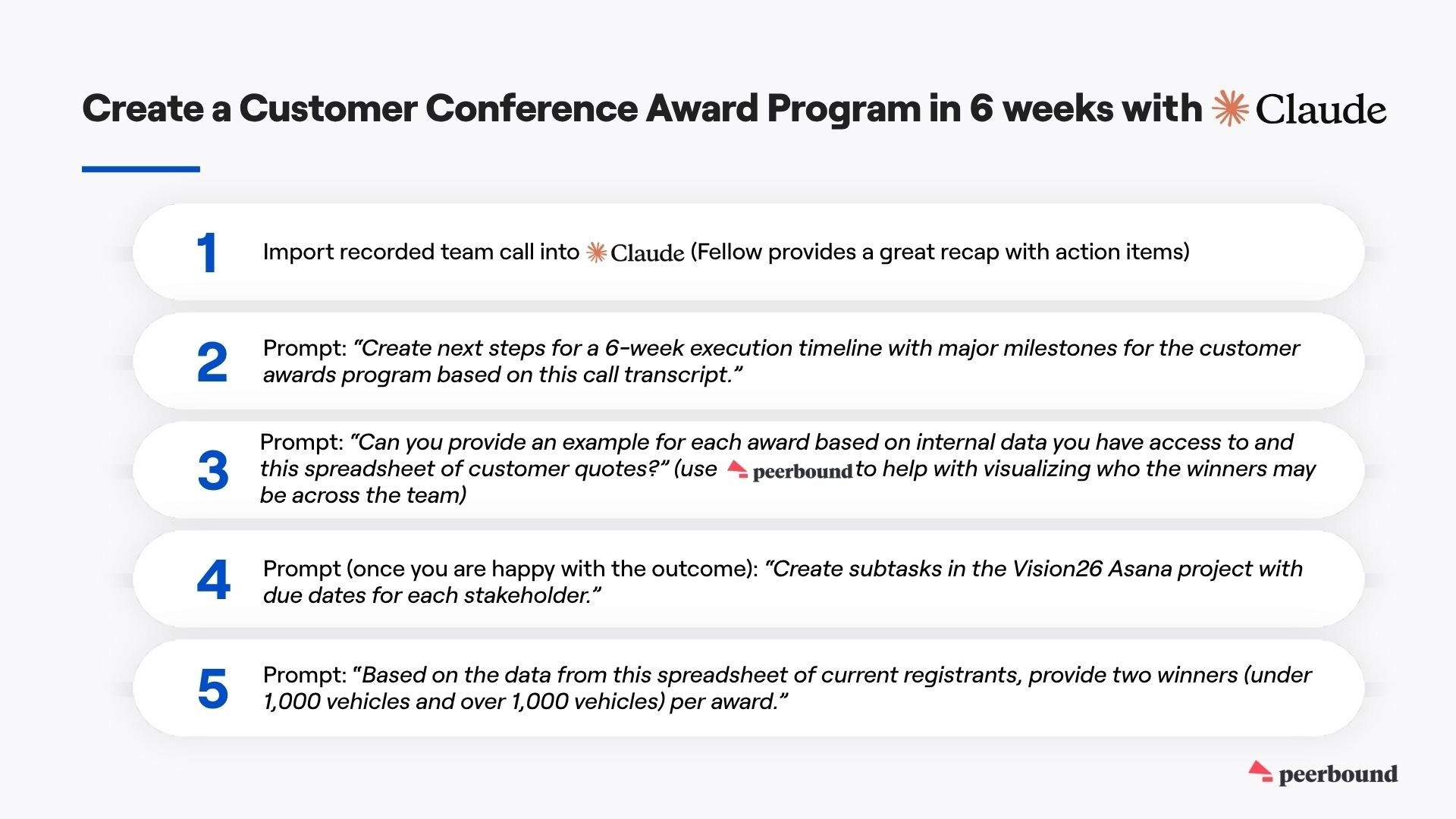
"I was able to create an awards program with the winners in technically one day's time. That's probably a 99.9% savings from doing this in six months."
The broader takeaway here isn't about awards specifically. Any project that involves using customer data to celebrate, segment, or activate your customer base can follow the same pattern. Export the data. Give AI the context. Let it do the first pass. Then apply your judgment.
How Crystal Anderson Built a Customer Proof Revenue Dashboard Without Engineers
Crystal leads customer marketing advocacy at Canva with a team of three. For context on the scale: Canva has over 260 million monthly users, 31 million paying seats, and 95% of Fortune 500 companies on the platform. A lean customer marketing team at that scale means AI isn't optional. It's infrastructure.
Her first use case tackled the question that keeps every customer marketer up at night: is our sales team actually using the customer proof we create, and is it influencing revenue?
The data already existed. Gong records every call. Guru tracks what content reps access. Slack shows where reps ask for proof. It was scattered across four platforms that don't talk to each other.
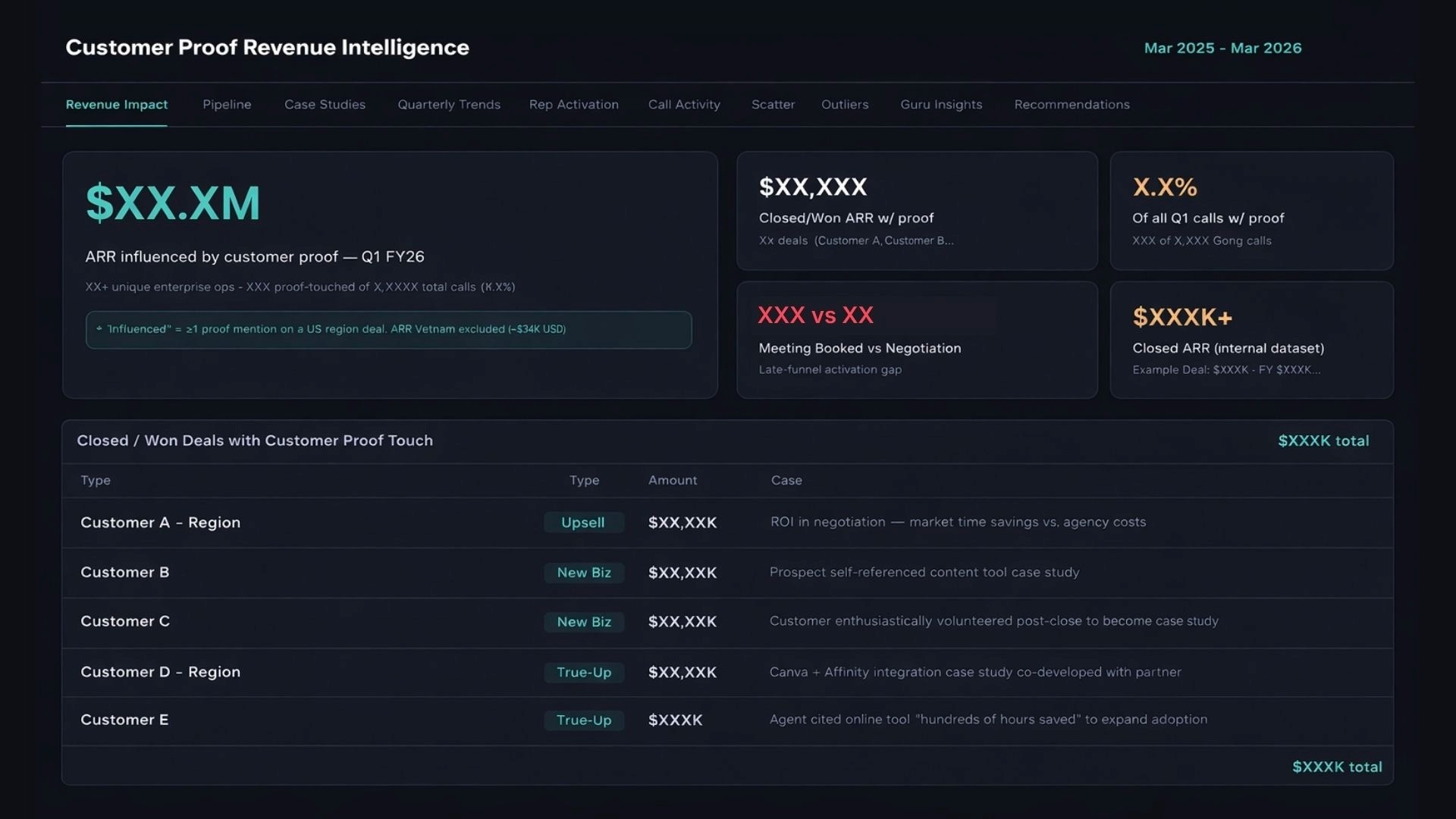
Crystal built a customer proof revenue attribution dashboard in Claude that stitched all of it together. She described the problem, uploaded data from each platform, and iterated on the analysis until the metrics held up.
"No engineers, no data team, no budget required. Just me, a clear question that needed answering, and Claude."
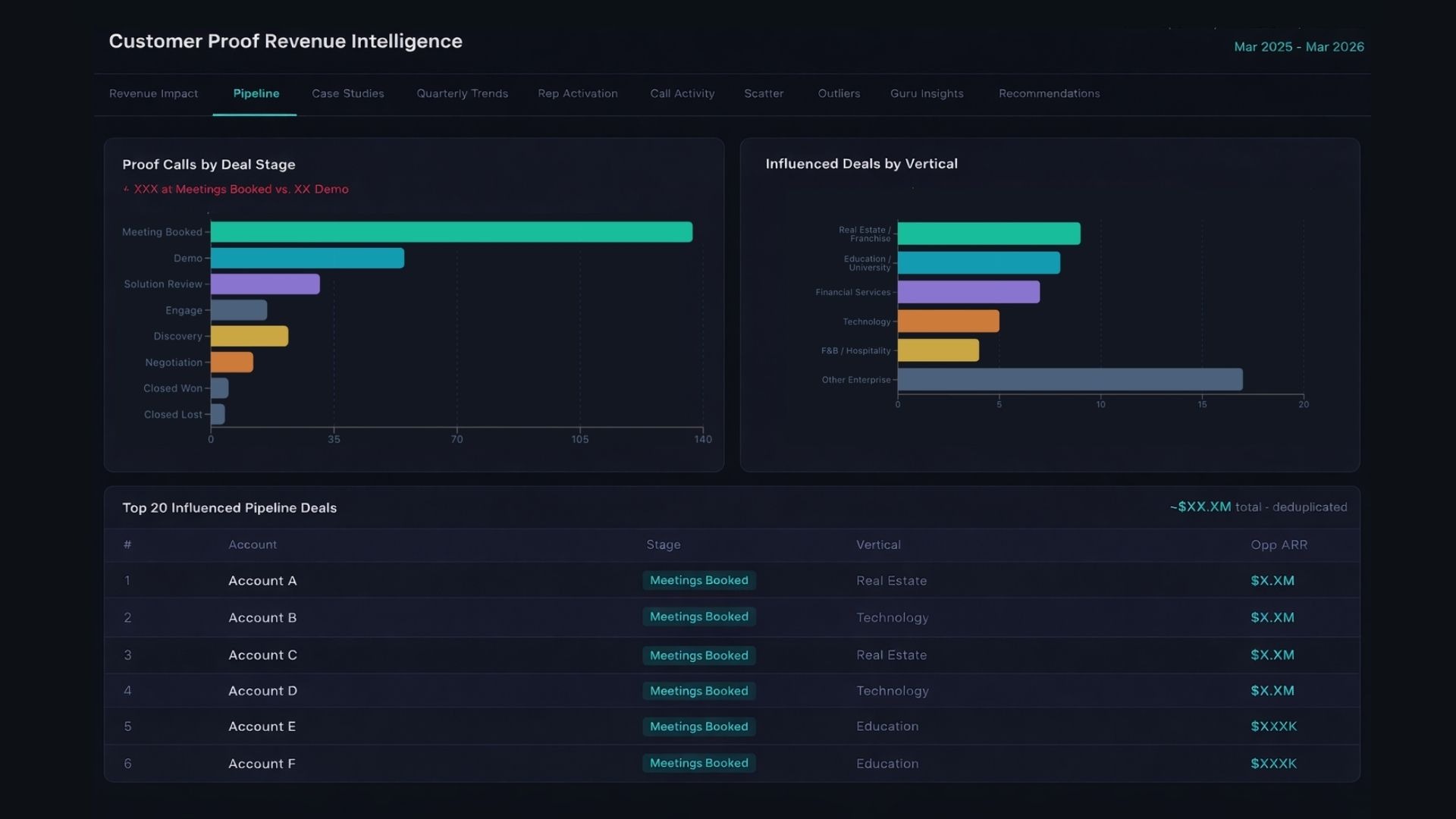
The dashboard now tracks three things that matter for proving the ROI of customer marketing: total ARR influenced by customer proof (active pipeline where proof was mentioned on at least one Gong call), closed-won ARR where reps demonstrably used proof in the sales motion, and activation rates showing what percentage of sales calls include customer proof at each deal stage.
One early finding: proof was being deployed early in deals but not carried through to negotiation and close. That's a late-funnel activation gap Crystal's team could now see clearly and address with targeted enablement.
She could also drill into individual deals. An upsell where ROI framing tipped the negotiation, sourced from a specific case study. A new logo where the prospect self-referenced a case study and the rep presented the full use case. These are signals, not assumptions.
How the Peerbound MCP Scales Customer Proof Across Every GTM Workflow
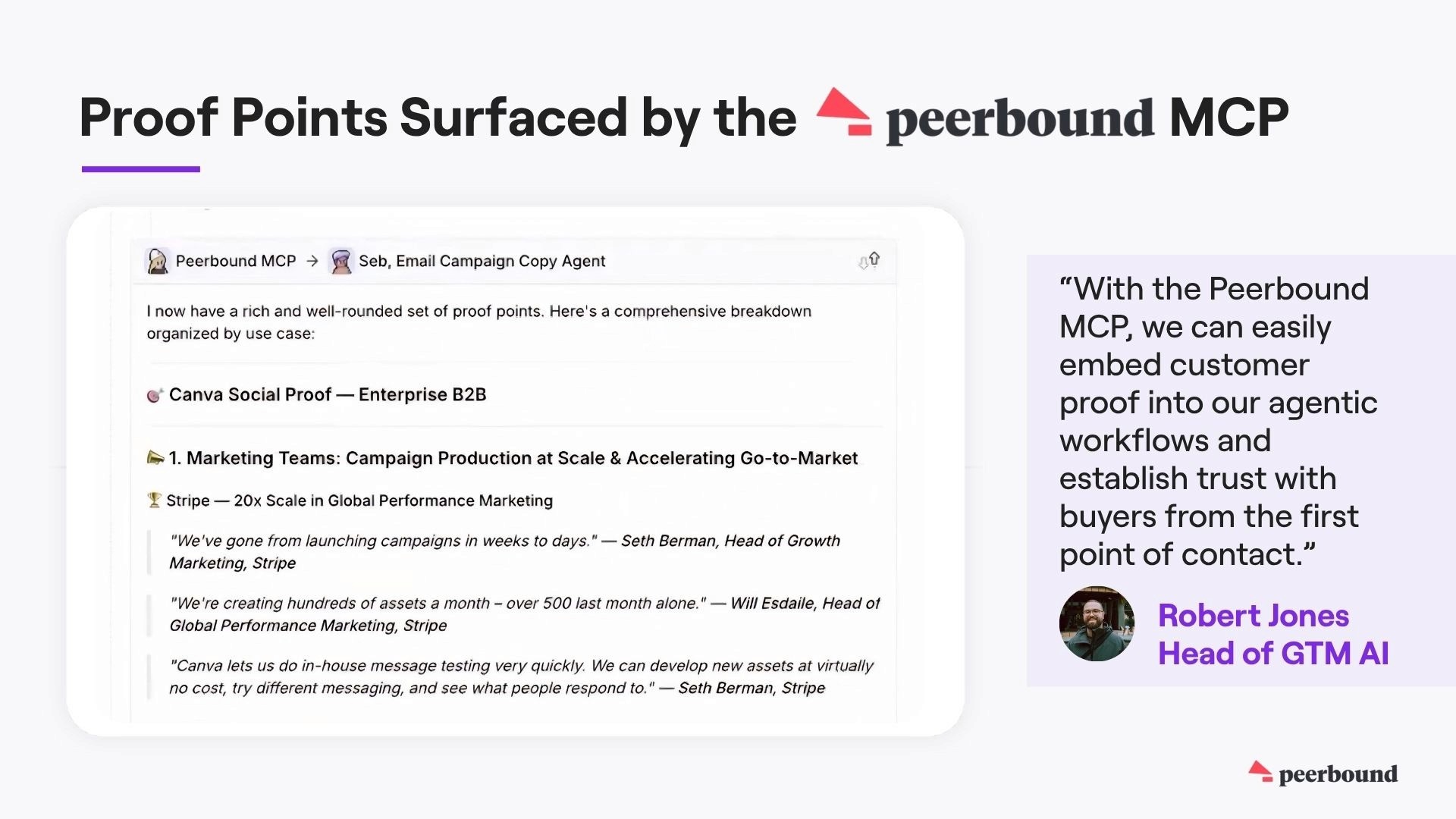
Crystal's second use case connected the Peerbound MCP to Canva's GTM workflows built in Relevance AI. When a prospect downloads content on Canva's website, the system identifies who they are, queries Peerbound's MCP for the most relevant customer story matching that buyer's industry and use case, and automatically inserts that proof into outbound email sequences.
A real estate company gets the real estate case study. A tech company gets Stripe or Salesforce. The heavy lifting of finding the right customer proof is done before a human touches the email.
The part that makes this genuinely scalable: when Canva's team publishes a new customer story in Peerbound, it's immediately available to every workflow. Outreach, meeting prep, follow-up emails. No one updates a separate database. It just flows.
"The teams that figure out how to use AI to scale signal discovery while keeping humans in the loop for the relationships and judgment calls are the ones that will pull ahead."
Crystal reported that in Q1, case studies influenced the largest amount of pipeline through SQLs of any lead type at Canva. She attributes that directly to having the right customer proof surface at the right time through these automated workflows.
Audience Q&A: Buy vs. Build, Resources, and What Moved a Real Metric
The audience had sharp questions. A few highlights.
How do you decide what to buy vs. build for customer marketing AI? Crystal was direct: buy where the use case is already solved for, build where it's specific to you. Peerbound was a clear buy for advocate identification and customer story management. The revenue dashboard was a clear build because it was specific to Canva's program metrics and tool stack. The internal sell wasn't a deck or a proposal. It was showing the output. She ran the initial dashboard, put it in front of leadership, and the conversation shifted from "should we do this?" to "how do we scale this?"
What resources help customer marketers learn AI beyond content creation? Liza recommended Kevin Lau's newsletter for its practical guidance on lifecycle strategy and custom AI workflows. He recently published over 100 Claude Code agents for customer advocacy and lifecycle management. Liza called it a gold mine.
What AI workflow actually moved a real metric, not just saved time? Both speakers had strong answers. Crystal pointed to rep activation data from the revenue dashboard. Because the team can now overlay proof usage against call volume by deal stage, they're working with enablement to increase customer proof at the right moments. The result: faster closes and clearer content gap analysis.
Liza pointed to the compounding effect of time savings. With hours freed up, her team ships more customer stories at greater scale, which directly affects pipeline. Her Q1 numbers backed that up.
The Bottom Line
Both Crystal and Liza landed on the same core idea, framed differently.
Crystal said it this way: the teams that build the right engine, using AI to scale signal discovery while keeping humans in the loop for judgment and relationships, are the ones that pull ahead.
Liza put it more simply: AI helps you run 80% faster, but the final 20% sprint is yours.
None of what they showed required a technical background. It required a clear question, the right data, and willingness to experiment. That combination is available to every customer marketer reading this.
Key takeaways for using AI in customer marketing:
Start with the question you need answered, not the tool you want to try
Customer data at scale changes what's possible for conference planning, content creation, and customer research
You don't need engineers or data teams to build dashboards that prove the revenue impact of customer proof
Peerbound’s MCP makes customer proof available to every GTM workflow automatically, with no manual updates required
Buy where the use case is solved, build where it's specific to your metrics and tools
AI handles the first 80%. The relationships, the judgment, the final sprint, that's yours
Watch the full recording here. And if any of these workflows sparked an idea for your own program, we'd love to hear about it.
Your customer proof should be in every deal, every email, every conversation. See how Peerbound makes that happen. Book a demo.
Five metrics that prove customer marketing's business impact beyond case study counts: time to match, reference impact, advocate NDR, sales adoption, and AI velocity.