
It starts with one gap. You need more evidence that your product works for a specific persona or use case, so you buy a survey tool: it sends the prompts and delivers whatever comes back, if anything comes back. Then sales needs that evidence in a usable shape, so you buy a second tool to turn a customer interview into a case study instead of writing one from scratch every time. Then someone starts using Claude for everything and asks why your customer stories aren't searchable inside it, so you find a third integration to bolt on.
A year later you're renewing three contracts, logging into three dashboards, and still fielding the same Slack message you got before any of this started: "Do we have a customer like this one?" You built a customer proof system. It just doesn't act like one.
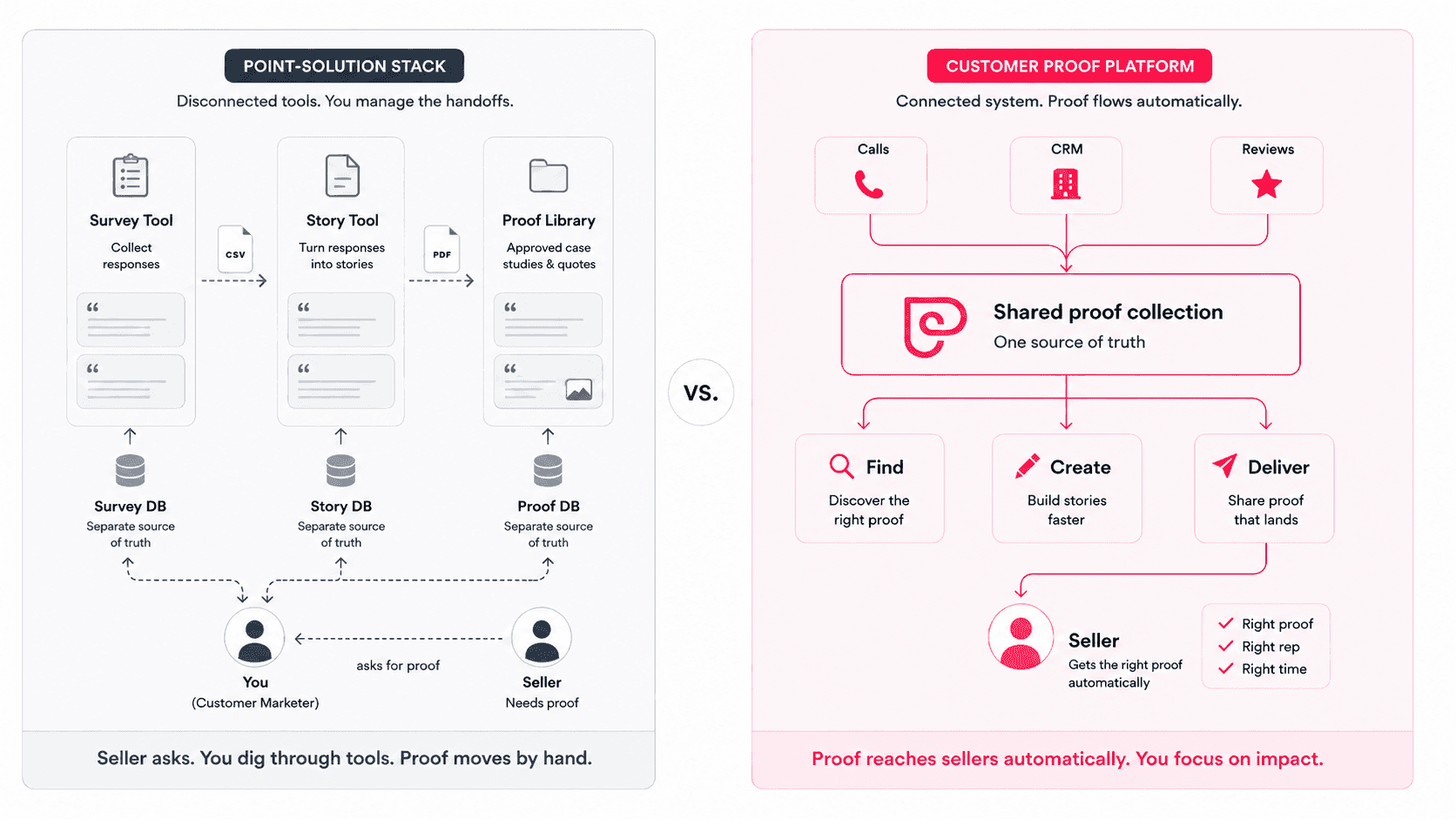
The real cost of assembling this yourself shows up in the space between the tools, where nothing hands off cleanly. A quote your legacy survey tool collects has to be manually moved into whatever creates your case studies. A story that tool drafts has to be manually pushed into whatever your reps search. Every handoff is a place proof gets dropped, forgotten, or goes stale before anyone finds it. Nothing connects those three tools, so the only thing left to close the gap is you: checking each one, copying by hand, hoping you remember where everything lives.
The gap between your tools is where customer proof goes to die
A stitched-together stack depends entirely on YOU to bridge it. The legacy survey tool depends on your customer replying to yet another request, and customers are busy, so plenty of that evidence never arrives. The story tool depends on you remembering to feed it a transcript. The search integration depends on someone remembering to upload the finished PDF so it has something to find. None of these tools know the other two exist, so customer proof only moves as fast as you can move it by hand.
That's a proactivity problem as much as a tooling one. A rep who needs proof mid-deal doesn't want to wait for you to notice their Slack message, dig through three systems, and reply by 10 PM. A quote sitting in a survey tool's dashboard does nothing for that rep until somebody manually carries it somewhere useful. Reactive, hand-carried customer proof mostly arrives too late to matter.
One customer proof platform eliminates the three you were stitching together
The old way | With Peerbound | |
|---|---|---|
Finding evidence | Depends on a survey going out and a customer replying, or you searching through recorded calls or account notes in your CRM | Continuous, pulled from calls, CRM, and reviews case study you already have |
Creating stories | A separate tool, a fresh transcript, an additional request each time | Built from what Moments already made visible, in minutes |
Announcing it's ready | Posted in Slack or Teams, then buried under the next marketing ask three hours later | Delivered automatically, tied to the deal and the objection it answers, which increase sales adoption of proof |
Finding it again later | Knowing what to search for and who to ask, whether that's the CSM who might know, the website, Highspot or Seismic, or somebody else's deck | One user-friendly collection, reachable wherever you already work: the platform, Peerbound MCP, or the Slack/Teams app |
What breaks first | Whichever handoff nobody remembered this week | Nothing to hand off. There's one, always-on collection. |
Each tool in a point-solution stack can work fine alone, and the stack can still fail as a system, because nothing in it was built to talk to the others. A customer proof platform closes that gap: finding, creating, and delivering proof all draw from the same collection, so nothing has to move between them by hand.
Manage outcomes, no handoffs
None of this means building the connective tissue yourself with scripts and a shared spreadsheet. That's just a fourth tool, and it's the one with no vendor to call when it breaks. A customer proof platform allows you to find, create, deliver, measure and optimize proof in a system where proof goes in and reaches sales, instead of three line items you reconcile by hand.
That's what Gayatri, Crystal, Neil, and Kerry all describe from different angles: less coordination, less waiting, less manual handoff, more time actually spent with customers instead of managing the disparate tools meant to represent them.
Book a demo to see how a customer proof platform can help your team.
Frequently asked questions
Do I really need a dedicated customer proof platform, or can I just use a survey tool plus a case study tool?
You can run that stack, and plenty of teams do, but you become the thing that connects them. A legacy survey tool only collects evidence customers choose to send back. A story tool only works once you've manually fed it a transcript. Without something reading from the same collection at every stage, you're the integration layer: checking each tool, copying quotes by hand, hoping nothing gets missed, not knowing how your work is impacting revenue.
What's the actual difference between Peerbound and a legacy survey-based tool like UserEvidence?
A survey-based tool is reactive: it sends a request and waits for the customer to respond, which means the evidence you get depends entirely on who replies. Peerbound listens to calls, CRM notes, and reviews you already have, so evidence gets found without asking a customer to fill out one more form. Kerry Wheeler at Lattice ran this comparison directly: "UserEvidence required too much additional work, like creating and sending surveys and then waiting and hoping for responses."
How is Peerbound different from a case study writing tool?
A case study tool solves one stage: turning a transcript into a draft. It still depends on you finding the right customer, scheduling the interview, and then separately getting the finished piece to sales. Peerbound's story creation draws on the same moments already made visible by continuous listening, so a story doesn't start from a blank page, and delivery gets the finished piece to the rep who needs it without a separate step.
Can Peerbound replace tools we're already paying for, like a survey platform or a sales enablement library?
It replaces the need to stitch several point solutions together for one outcome: getting the right customer proof to the right rep at the right moment. Peerbound covers finding, creating, delivering, measuring, and optimizing proof as one system, so you're not maintaining separate subscriptions and manually carrying evidence between them.
What does it look like in practice when a company switches from a point-solution stack to Peerbound?
Motive's team runs on scale most companies don't have to plan for: over 100,000 customers. Before Peerbound, finding advocates depended on CSM nominations, and writing up their stories took hours per interview. After bringing finding, creating, and delivering proof together in one platform, Motive cut content creation time by 50%, because discovering a story and getting it in front of a rep stopped being two separate jobs run through two separate tools.
Most teams stitch together a survey tool, a case study writer, and an enablement library to manage customer proof. Here's why a single platform works better.