It's the day after your quarterly board meeting, and you're still turning over the question that got asked. The board looked at the AI consulting line item, $75,000 for the quarter, and asked what it did to increase pipeline, win rate or deal velocity.
You had an answer ready. Twelve case studies published. Forty AI-sourced quotes formatted and approved, plus three prompt playbooks and associated Claude Skills the consultant handed off before the engagement wrapped. It's a real body of work, and it took real budget to produce.
None of it answers the question. You can't open Salesforce and show which of those twelve case studies touched a closed-won deal, because the consultant who built them never connected to your CRM in the first place. They built deliverables. They didn't build a system that keeps watching what happens after delivery.
This kind of board meeting is playing out anywhere content budgets get reviewed this quarter. 56% of B2B marketers say they struggle to attribute ROI to their content efforts, according to research from Content Marketing Institute and MarketingProfs. That gap traces straight back to how the content got made.
Customer proof, the quotes, stories, and reviews that show real buyers already trust you, either comes from someone who builds it once, or a system that keeps building it. Your board only cares about the second one. That's one of the real decisions hiding inside every AI content automation conversation happening in marketing right now: hire an AI marketing consultant, or buy a platform. The real decision is how long you want the work to keep producing an answer after the invoice is paid.
How do I choose between an AI marketing consultant and a platform for content automation?
Ask what happens the day the engagement ends.
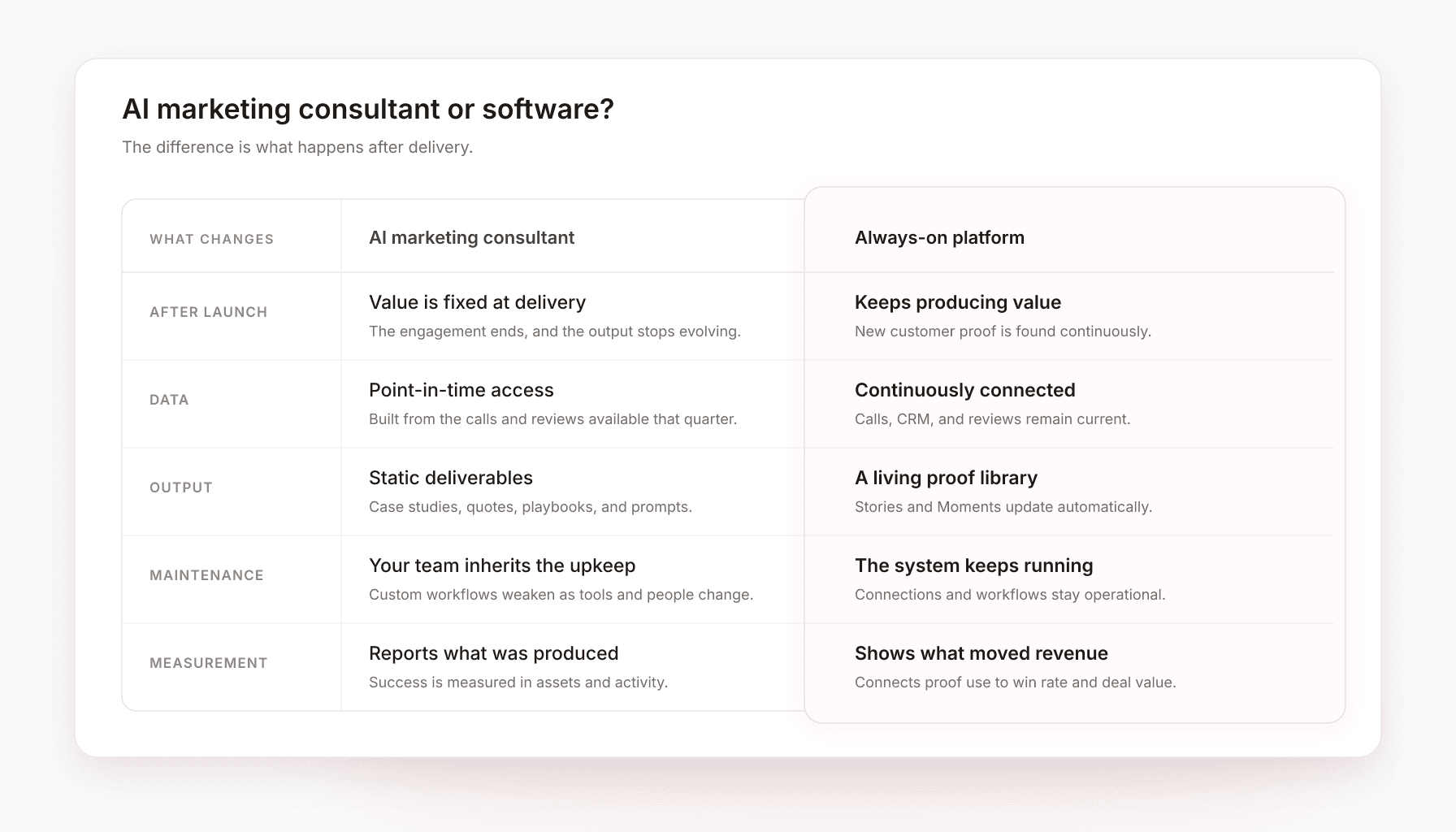
A consultant's value is fixed at the end of the engagement. Because they deliver static assets, that work stops evolving the moment the contract ends, regardless of your ongoing customer conversations.
A platform's output is what it produces every day after that, because it's still connected to the calls, the CRM, and the reviews generating new proof.
A consultant can tell you what they built. A platform can tell you what's working right now, and the revenue it's driving.
If your board wants a status update once a quarter, either approach can hand you a slide. If your board wants a number that updates itself, only the platform approach can provide that.
What does an AI marketing consultant actually cost after the contract ends?
Most consulting engagements leave behind what's really a set of custom instructions duct-taped to your existing tools:
A Zapier webhook pulling call notes into a spreadsheet.
A shared Google Doc functioning as the "quote library."
A ChatGPT project pre-loaded with the consultant's prompts.
It works, for a while, because the person who built it still remembers how the pieces fit together.
Then that person leaves, or your call recording tool changes, or someone renames a field in Salesforce, and the webhook breaks. Nobody notices until the "quote library" hasn't had a new entry in two months and a rep asks why. Nobody's paid to keep it running once the statement of work closes, so, eventually, it breaks.
How long does content from an AI marketing consultant actually stay useful?
Call it a 90-day half-life. Sharp and useful on delivery day, because it's built from the freshest calls and reviews you have at that moment. Then it starts fading, because your customer base keeps talking after the consultant stops listening.
Every day after the engagement ends, more of what customers actually say happens somewhere the deliverable can't reach:
A new objection raised on a call.
A CSM's note about a renewal at risk.
A G2 review that names the exact competitor your sales team is losing deals to this quarter.
A deal that just closed and could be the reference story for the next ten prospects like it.
A static deliverable can't go get any of that. It can only get older. A system built to keep listening doesn't have that decay curve. It compounds, because every call and every closed-won deal becomes more material for it to work with. In a proof system, your library grows with you.
Can you actually trace customer proof to revenue, or just to activity?
Peerbound Measure exists because customer marketers have always been measured on the wrong thing. Gainsight (a verified Peerbound customer) is one of the customers already using it this way. "Customer marketers have always historically just measured output, but the amount of case studies you produce is not a business metric decision makers care about," said Chris Dalton, Principal, Customer Marketing at the company. "Now with Measure, we can show the impact of proof on win rates and revenue, which team members get the most value and when during the deal cycle, and what proof moves the most deals. It's groundbreaking, not just an incremental improvement."
Measure connects every proof touchpoint from an email send to a call mention straight to the deal in Salesforce, so you can see which stories closed which deals and how win rate shifted when proof was in the room. Enable (a verified Peerbound customer) is seeing the same shift from the other side of the dashboard. "In just the last week and a half, with Peerbound Measure, I've been able to see its dollar impact," said Luis Gonzalez, Director of Customer Advocacy at the company. "The data shows our win rates are higher and deal sizes are bigger when customer proof is mentioned."
That's the difference between walking into your next board meeting with a list of what you built and walking in with a number.
What does a working customer proof system actually look like?
It looks like proof that keeps arriving on its own, without anyone digging for it.
Peerbound's Find agent listens across your calls, CRM, and reviews continuously, at a volume no single person could keep pace with on their best day, and uncovers the stories and quotes your team would never turn up on their own. Peerbound's Deliver agent then gets that proof to reps automatically, in Slack or by email, matched to the objection the prospect actually raised, instead of waiting for a rep to ask for it.
Lattice (a verified Peerbound customer) shows what that looks like at scale. Kerry Wheeler, Director of Product Marketing at the company, watched proactive proof emails land with almost 70% open rates across her sales team, and $13 million in deal value and closed-won ARR attributed directly to the customer proof her team found and put in front of reps.
AlphaSense (a verified Peerbound customer) saw the same pattern from a different angle. Brittnee Dawson, Director of Customer Marketing at the company, watched a 600-person revenue team grow its proof Slack channel from 200 to 400 people on word of mouth alone, with engagement doubling in under a month and quotes getting approved in under two hours instead of sitting in a queue. None of that required a new engagement. It just kept compounding.
The board room question, answered
Your board didn't ask how much content you made last quarter. They asked what it did. A consultant can help you answer that question once, for one quarter, with whatever they built before they left. Peerbound answers it every quarter, on its own, because it's still connected to the calls and deals generating the answer.
See how AlphaSense scaled customer proof across a 600-person revenue team without adding headcount in the full case study.
An AI marketing consultant delivers case studies for one quarter. See how Peerbound customer Lattice ties always-on customer proof to $13M in attributed deal value.