
I spent a few years at the director level before I understood why I was stuck there.
In that stretch I had two kids and took two maternity leaves, and came back each time to more responsibility, not less. I'd started out running customer lifecycle. When I came back from the first leave, I took on the prospect side too, and rebuilt our nurture program from something that existed into something that worked: a channel that put a predictable number of leads into pipeline every quarter. I handed the whole team what I'd learned about email, so the entire program got stronger, not just the piece I owned. On the side, with no budget and barely any internal support, I built an account-based marketing community from nothing. I mentored people across the team and helped more than one of them build the case for their own promotion.
None of that was small. And I still didn't move.
Here's what I eventually had to admit: a promotion depends on what the people two levels above you think of your work, not just what your peers and reports think of it. You can be doing the job at a level your title hasn't caught up to yet and still get passed over, because visibility doesn't accumulate just because the work is good. It has to be built on purpose, and building it costs something real: more meetings, more time in rooms you'd rather not sit in, less time with the people who matter to you outside of work. For me, with two young kids, that trade wasn't one I wanted to make, and that's the same tradeoff a lot of directors run into without ever naming it out loud.
I'm not the only customer marketing leader who's lived some version of this. Peerbound's podcast exists because these conversations, about what actually moved someone's career and what actually stalled it, tend to happen in private, at a conference bar, not out loud where the next person could learn from them. So here's 10 pieces of customer marketing career advice from leaders who've put it on the record about what actually builds a case for the next title.
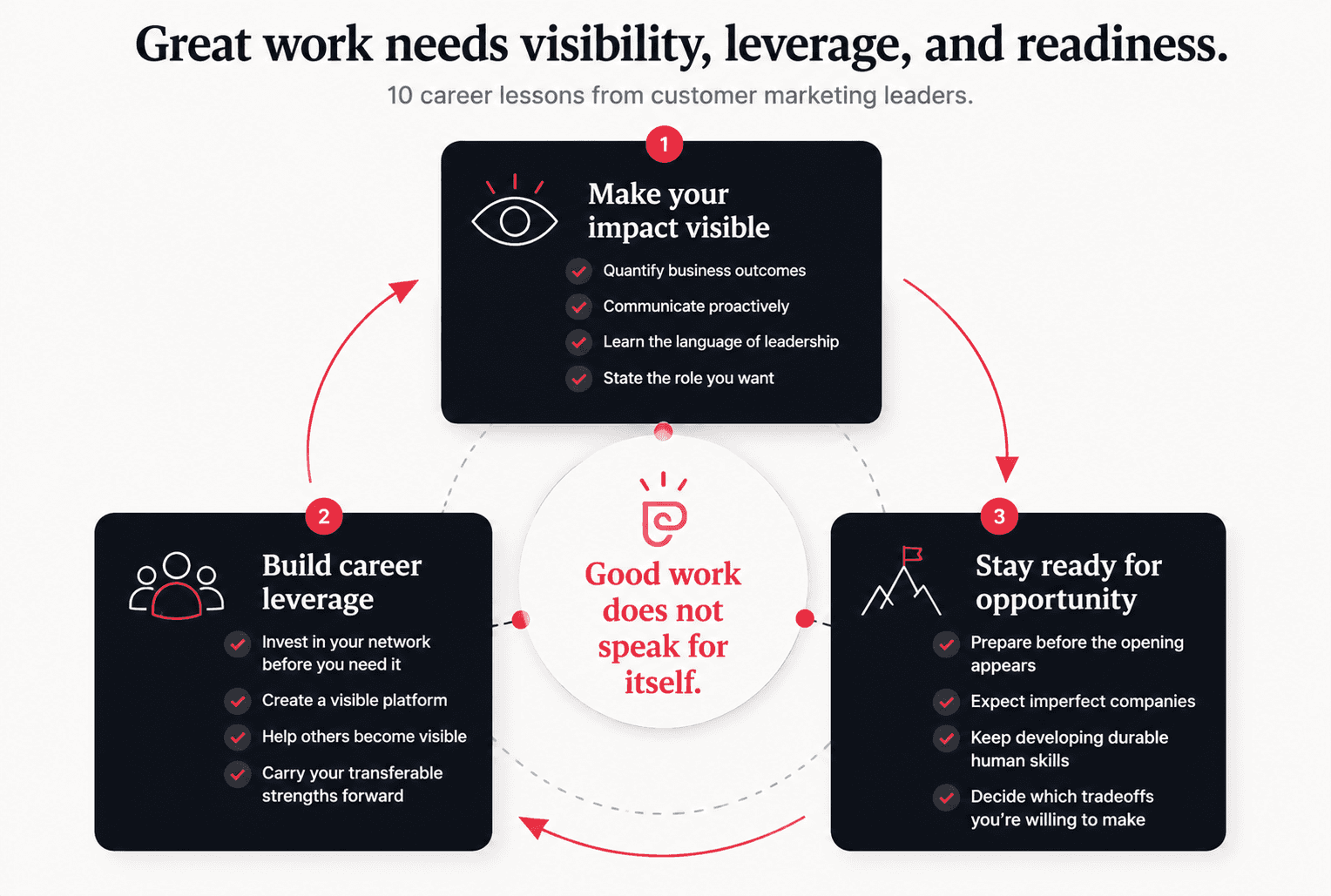
1. Visibility is earned, not granted by the title.
Kevin Lau, VP of Customer Engagement at Freshworks, put it plainly on the Peerbound Podcast: “If no one knows what you're doing, if they can't quantify exactly what is the impact you're driving within the organization, some executive could just say, does this function even need to exist?” His fix is to communicate proactively, the exact instinct I was missing. “How do you get that visibility?” he said. “It's being able to communicate proactively.”
2. Don't leave your path to your boss's imagination.
Lau's second piece of advice follows straight from the first: name the outcome you actually want. He talked about giving his own manager options rather than waiting to be handed one. “I don't think you necessarily want to just leave it in the hands of your boss to decide what that could be,” he said. “I think you have to give them options.” Nobody can advocate for a path they don't know you're on.
3. Career breaks are luck meeting preparation, not luck alone.
Visibility explains why some people get seen. It doesn't explain why an opportunity shows up when it does. Ali Jawin, CMO at Pontera, has talked about a relationship that resurfaced years into her career and changed its direction. Her read on it: “it is a combination of luck and preparation.” The preparation is yours to control, even when the luck isn't. “What you can control is being as prepared as you can,” she said, “so that when these opportunities do strike, you can take them and you're ready for them.”
4. Calibrate your expectations of any company you join.
Jawin's second piece of advice is the more deflating one, and the more useful one. She leans on a line she borrowed from Latané Conant, CRO at 6sense: “every company is on a sliding scale from hot mess to dumpster fire.” No company is the fantasy version you pitched yourself in the interview. Knowing that going in changes how you read the friction once you're inside.
5. It comes down to network.
Michael Sciano has coached people through job searches for twenty years, and he'll be the first to admit the answer is a cliche. He said it anyway, because it's true: “it comes down to network.” He's found jobs in 15 days, 17 days, 30 days, more than once. Sciano's network took years to build, well before he needed to call in a favor.
6. An unconventional path is an asset, not something to explain away.
A network gets you in the room. What you bring once you're there is a different question, and it doesn't have to look like a straight line. Mel Cornford, Customer Marketing Lead at Canva, spent ten-plus years in journalism before her team was laid off during the pandemic. “My path was not a conventional one,” she said of the switch that followed. She reached out to her network deliberately, built relationships with people at companies she wanted to join, and carried her journalism instincts, structure, pacing, knowing what makes a story worth telling, straight into customer marketing.
7. Humanities and critical thinking are durable career capital.
Emily Coleman, Customer Marketing and Advocacy Lead at LaunchDarkly, studied English literature and has never regretted it. “Humanities are gonna be as important as ever,” she said, “because regardless of whatever happens with machine learning, AI, and all of that, we still need folks who can think critically.” The skill under the skill is what survives whatever tool comes next.
8. Let other people build their own visible platform, inside real guardrails.
Harriet Johnston, VP of Marketing at Ashby, treats her team's personal visibility as an asset to the company rather than a threat to it. “Helping people build their own platforms or brands within your organization, as long as it's done within kind of the guardrails that you need it to, is awesome,” she said. If you already have brand and product right, she added, “you've got 90% of the assets” to do this well.
9. The human story is a job AI can't take from you.
The same instinct that makes someone good at building other people up is the one no tool can replicate. Brittnee Dawson, VP of Product & Customer Marketing at Service Express, uses AI constantly to surface signals and speed up her work. But she draws a firm line around the part that still has to come from a person. “Data is never gonna tell, ‘Hey, this made me feel really awesome. This helped me advance my career. This company changed my life,’” she said. “I might be naive because I'm passionate about it, but I don't think AI can replace that.” Customer marketers, she said, have “a strategic advantage” precisely because the job has always been human-centric.
10. Learning the language of leadership changes whether you're heard.
Johnston again, on what actually shifted her own influence: picking up the mechanics of the business made her fluent in rooms that used to intimidate her. “It made such a difference to how I could communicate,” she said, “because suddenly I could show up in meetings, presenting ideas or strategies in the same language as our sales, finance, and sort of the rest of the leadership team.” That's the exposure I didn't have enough of. It's also the one piece of advice on this list that's fully in your control starting today.
None of these are shortcuts
Lau still had to do the extra work of communicating what he'd already earned. Jawin still had to sit through companies that were closer to dumpster fire than she'd hoped. Cornford still had to rebuild a network from a standing start after a layoff. What they have in common is that they built the visibility, the relationships, and the fluency that let good work actually get heard, instead of assuming the work would speak for itself.
I didn't build all of that at director level, and I'm glad I made the choice I made. But I wish someone had told me the choice existed and had a name, instead of finding it out the hard way, one performance review at a time.
For more customer marketing career advice like this, from leaders on the record about what actually moved their careers, listen to the Peerbound Podcast.
Career advice from customer marketing leaders at Freshworks, Canva, LaunchDarkly, Ashby, and more on visibility, networking, career paths, and getting promoted.