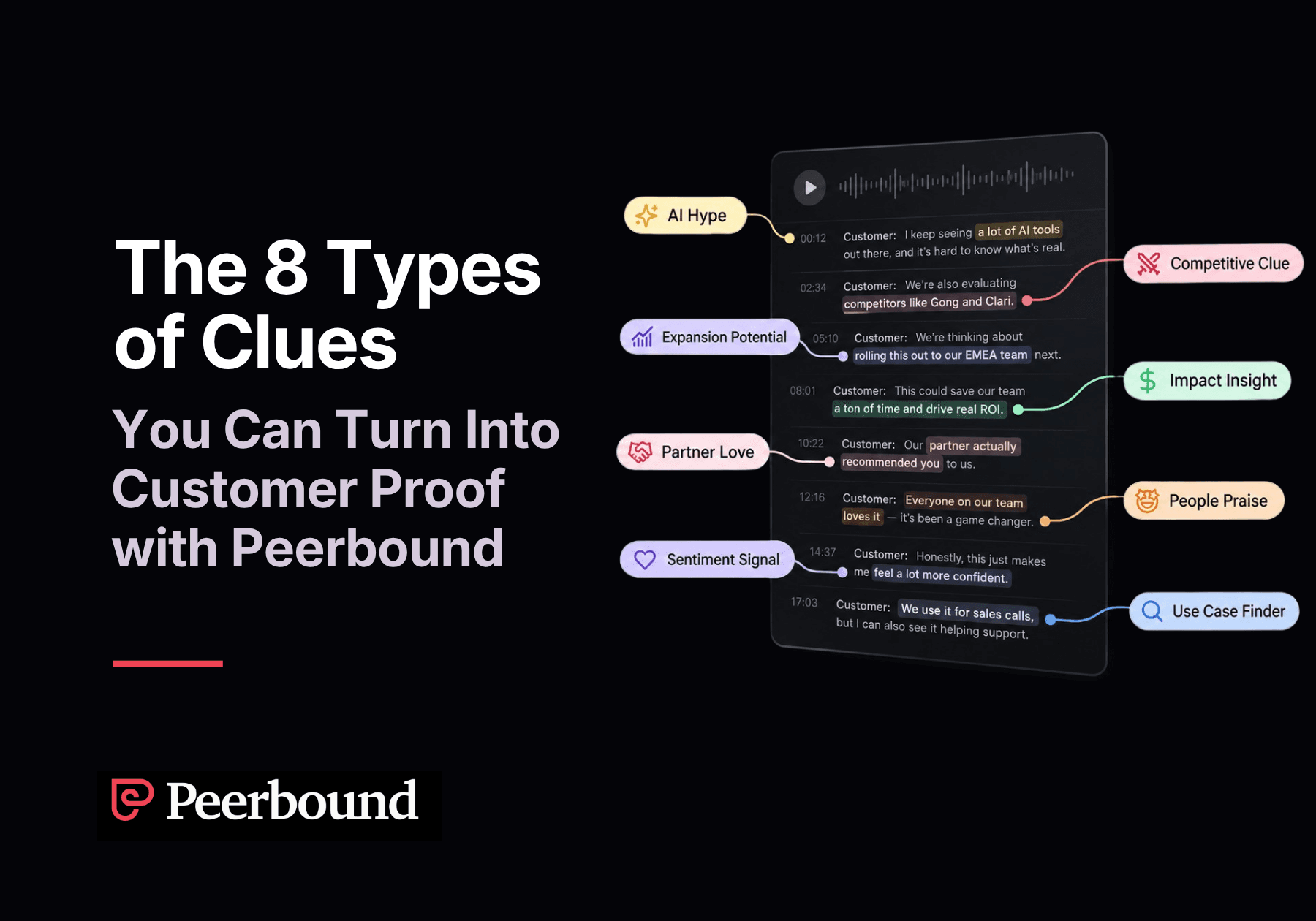
Customer marketers have always known customer proof helps move deals, but proving it with reliable data, down to a specific rep and deal, has been nearly impossible. Peerbound built Measure to solve exactly that, tracking every sales call and outgoing email against a deal's stage so impact finally has real numbers behind it.
On Sept. 15, three customer marketing leaders who have been running on Peerbound Measure since early beta came together to share what they found with the numbers and what they're doing with them now.
Key points:
Historically, customer marketers couldn’t prove customer proof moved deals. Now they finally have access to the data that does, and it’s revealing that deals with proof win 5 to 15 percentage points more often. Even better, it’s showing that when reps use it twice in a deal, that number roughly doubles.
One big number didn't tell anyone what to do, so break it down by rep and by deal. Then a sales leader can see exactly who needs coaching and which deals proof actually helped close.
None of the three panelists are fixing the seller adoption problem by producing more content. The fix is distribution and habit: figuring out where reps are using proof and how they are using proof.
What are the early results?
Across Peerbound's beta customers, the same pattern shows up company after company: deals using customer proof win 5 to 15 percentage points more often than deals that don't, and that lift roughly doubles when proof appears across more than one stage.
At Canva, Crystal Anderson revealed that deals using customer proof win at a 33% higher rate than deals without it, a lift she called significant given how large enterprise deals are. Chris Dalton also has seen positive results at Gainsight, sharing that deals using proof win at 2.5 times the rate of deals that don't.
Thao Littler from Crunchtime now has visibility into something she never did before: she can see that a specific rep just used a specific customer story on a specific deal today, while the deal is still in progress. This visibility is what shifts customer marketing from reporting on the past to coaching reps in real time.
Why was this hard to prove before?
All three panelists were reporting outputs, not outcomes.
Thao called her old numbers "productivity metrics cosplaying as impact metrics," or in other words, proof that she was busy but not proof that any of her work moved a deal. Chris described a slide he used to bring to leadership as "here's my art project," since it included a case study he could show off but couldn't connect to a result. Crystal pulled data manually from several platforms every quarter, which required hours of work but produced only a program-level number, and never a per-rep or per-story view.
The deeper issue, Crystal addressed, is that usage and attribution are two different problems. Just because proof was used on a deal doesn't mean proof caused that deal to close. To know the difference, you have to control for things like deal type and size. Getting that right, and trusting the number enough to bring it to leadership, is what takes real work.
How does the tracking actually work?
Peerbound listens to every call and every email reps send, from the moment a deal opens until it closes. When a rep mentions a customer's use case or testimonial, Peerbound matches it back to that story, quote, or review. All three panelists agreed on one thing: merely naming a customer doesn't help win a deal, but mentioning a real use case from that customer does.
What are they doing with data from Peerbound Measure?
Chris built a Claude skill using Peerbound's MCP server, which pulls proof-related data from Gong call transcripts, Slack messages, and prospect emails. His skill compares three things against each other: what sellers are asking for, what they're actually using, and what prospects are bringing up on calls. These insights separate two problems that used to look the same from the outside. One is a proof gap, where the story sellers need doesn't exist yet, and the other is an adoption problem, where the story exists, but nobody's using it.
The second thing Chris does is export the rep-by-rep, deal-by-deal data from Measure and asks Claude to write it up as a narrative for quarterly business reviews. With the rep-by-rep, deal-by-deal export turned into a narrative, Chris can name that “Scott used proof the most and got the biggest win-rate lift, or that Meredith's biggest deal closed on the strength of a specific story.”
Crystal pulled her own analysis to bring to leadership, based on the 2,000+ proof pieces, 130+ referenceable logos, and the adoption rate. She used those numbers to justify a strategy shift: find better ways to surface existing stories rather than ask leadership to fund more case studies. She also partnered with sales enablement to run polls and surveys once the data showed which reps weren't using proof, digging into the "why" behind the numbers rather than just reporting them.
How are they getting sellers to actually use it?
The three panelists revealed their new strategies for building customer proof adoption:
Embed proof in onboarding. A new rep facing an empty Slackbot with no idea what to ask is a rep who never uses it. Thao embeds sample queries for Peerbound’s Slack App directly into onboarding so new reps try it themselves in week one, before they've built a habit of working without it.
Lead with one striking number rather than a full dashboard. Chris found that sharing a single stat (deals using proof win at 2.5x the rate) did more to drive adoption than any tool rollout. That stat alone drove half a dozen new conversations with people across the business who wanted to replicate the result.
Make the rollout sales enablement's job too. Crystal is teaming up with sales enablement at Canva to dig into the "why." With her new data on which reps weren't using proof, Crystal partnered with enablement and ran surveys to understand what those reps were doing instead.
Publicly recognize what's working before enforcing anything. Instead of nagging reps to use customer proof at Crunchtime, Thao shows them who's already doing it right. Using the rep feed in Peerbound Measure, she spots who's using proof well and shouts them out by name in sales syncs, "here's what good looks like, go do this."
Why not build it internally?
Crystal had already tried building something like this herself. It started as a prototype at a Canva AI hackathon, and it worked, but it also meant constantly spending her time maintaining a proof library, a Slack-and-email bot, and Gong call tracking. Every outage, every data gap, every feature request landed on her: "The real cost of a free internal build was the cost of me," she said.
Even with tracking sorted, having the data doesn't automatically change what reps do. The lift is real, at Canva, at Gainsight, wherever proof actually gets used. What's still catching up is distribution: getting customer proof into onboarding, into coaching, and into the tools reps are already running.
Customer proof wins deals. Now there's data to prove it.
Want to get proof off the shelf and into your reps' actual calls? The full session covers audience questions too. Watch the recording or reach out, and we'll show you what Measure would find in your own deals.
Frequently Asked Questions
What is Peerbound Measure?
Peerbound Measure tracks how often reps mention customer proof, on calls and in emails. It matches that to a specific deal and a specific story. Then it connects it to win rate, from a deal's first stage through close. Early data shows it works. Deals that use proof win 5 to 15 points more often.
What's the difference between a proof gap and a seller adoption problem?
A proof gap means the story a seller needs doesn't exist yet. An adoption problem means the story exists, but reps aren't using it. Chris Dalton at Gainsight built a tool to tell the two apart. He used Peerbound's MCP, and he compared what sellers ask for against what prospects raise and what's already in the proof library.
Does creating more customer content fix low proof usage?
Not based on what these teams found. Canva already had more than 2,000 proof assets. Distribution and habit moved the needle, not volume.
Where can I watch the full webinar?
The recording of "Off the Shelf: Getting Sellers to Actually Use Your Customer Proof" is here.