
Every Sales Kickoff, Marketing gets one shot at a room full of reps who are actually paying attention. Demand Gen walks the room through next year’s integrated marketing strategy, and the sequences aligned to each persona and theme that will trigger when an inbound lead qualifies. Product Marketing rolls out a series of competitive plays and tells reps exactly which slide to pull when a specific competitor's name comes up in a deal. Then customer marketing gets ten minutes to play a reel of the best customer stories from the past year. The room claps. Morale is high. Everyone heads to happy hour.
Three months later, a rep is mid-call, a prospect asks for a reference in their specific industry, and the rep remembers there was a new story rolled out recently that fits the bill, but doesn’t know where to find it.
Demand Gen and Product Marketing built a trigger into their programs: a lead arrives, a rep runs the play. A competitor comes up, a rep pulls the slide. Customer proof rarely comes with that same trigger motion, so the story that revved Sales up at SKO isn’t actionable. And nobody has a way to know whether Sales walked away using your refreshed proof library.
Peerbound Measure is how you know.
It ties every story, quote, and G2 review shared over a call or through email to the exact deal it touched in Salesforce, then tracks what happens to that deal next. Proving the impact of your work stops being a guess and starts being a screen you can pull up on demand.
We've written before about why proof programs run on faith instead of data. Peerbound Measure is what closes that gap, and it's available today for every Peerbound customer.
How to Tie a Specific Case Study or Quote to a Specific Closed-Won Deal
Here's what happens once Measure is turned on:
A rep mentions your case study on a call, or drops a quote into a follow-up email.
Peerbound catches the mention and matches it to the exact deal it touched in Salesforce.
Measure keeps watching that deal as it moves, stalls, wins, or gets closed lost.
Every touch gets logged against a rep, a deal, and an outcome, automatically, with no Customer Marketer chasing it down.
From there, you get a live view of what all of that adds up to:
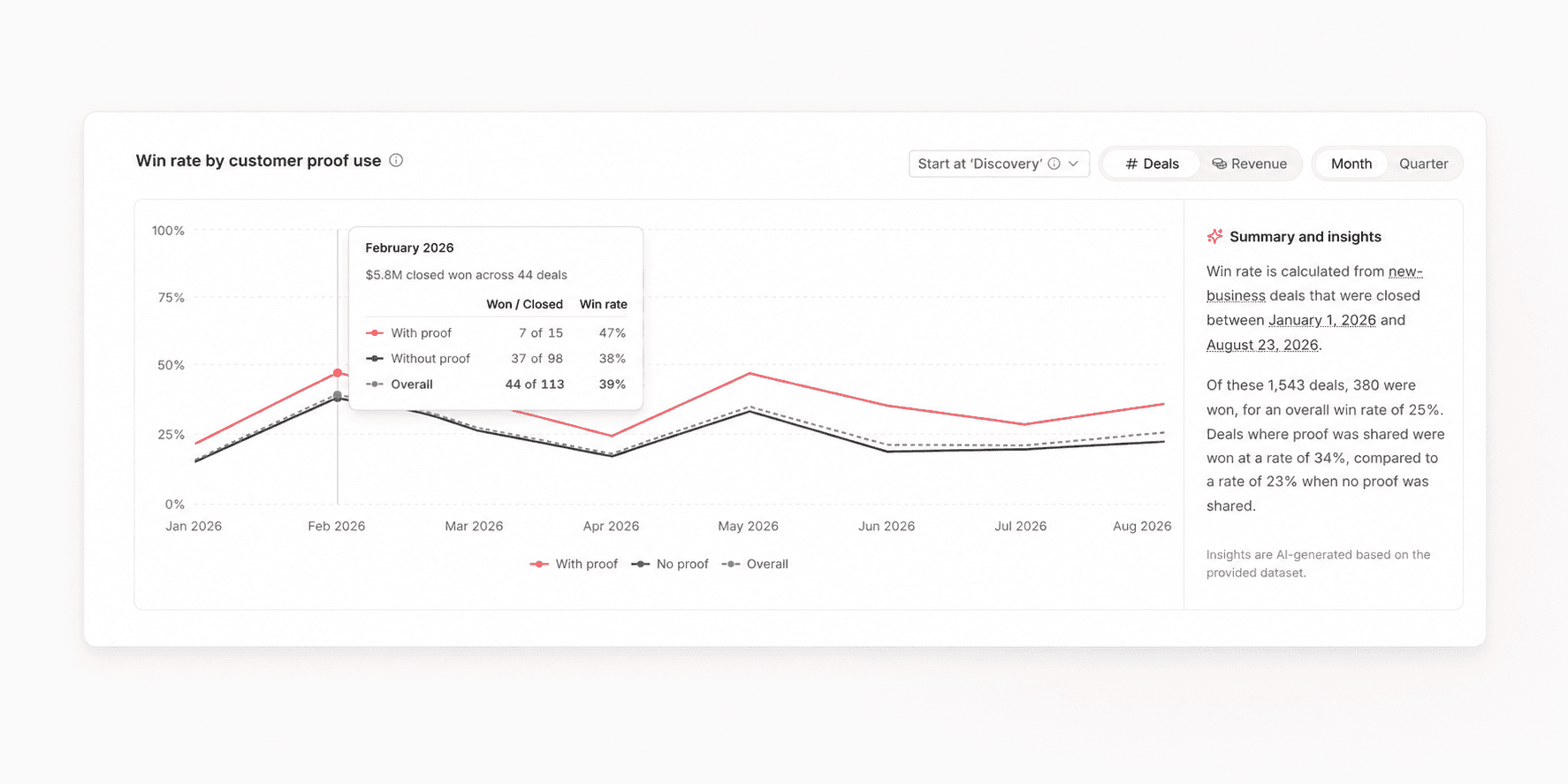
Three numbers that leadership cares about: Win rate, impacted new business revenue, and deal velocity, compared between when proof is used or not used.
A trend chart: see proof usage by week, month, or quarter.
Filters that match your CRM: segment, stage, region, deal size, rep, account, and more.
A CSV export, any time, for anyone on your team who wants to build their own view.
When a deal closes, you're not left guessing whether proof helped. You can trace the result back to the exact story, the exact rep, and the exact moment it got used.
One of the benefits of Peerbound Measure, as Chris Dalton, a customer marketing leader at Gainsight (a verified Peerbound customer) explains, is that it requires no behavior change. “What I like about Peerbound Measure is that it provides a holistic view into how proof is being used across the business without requiring reps to follow a specific workflow. Measure just finds all proof being mentioned on calls and in emails.”
Walk Into Your Next QBR With a Plan, Not a Slide of Logos
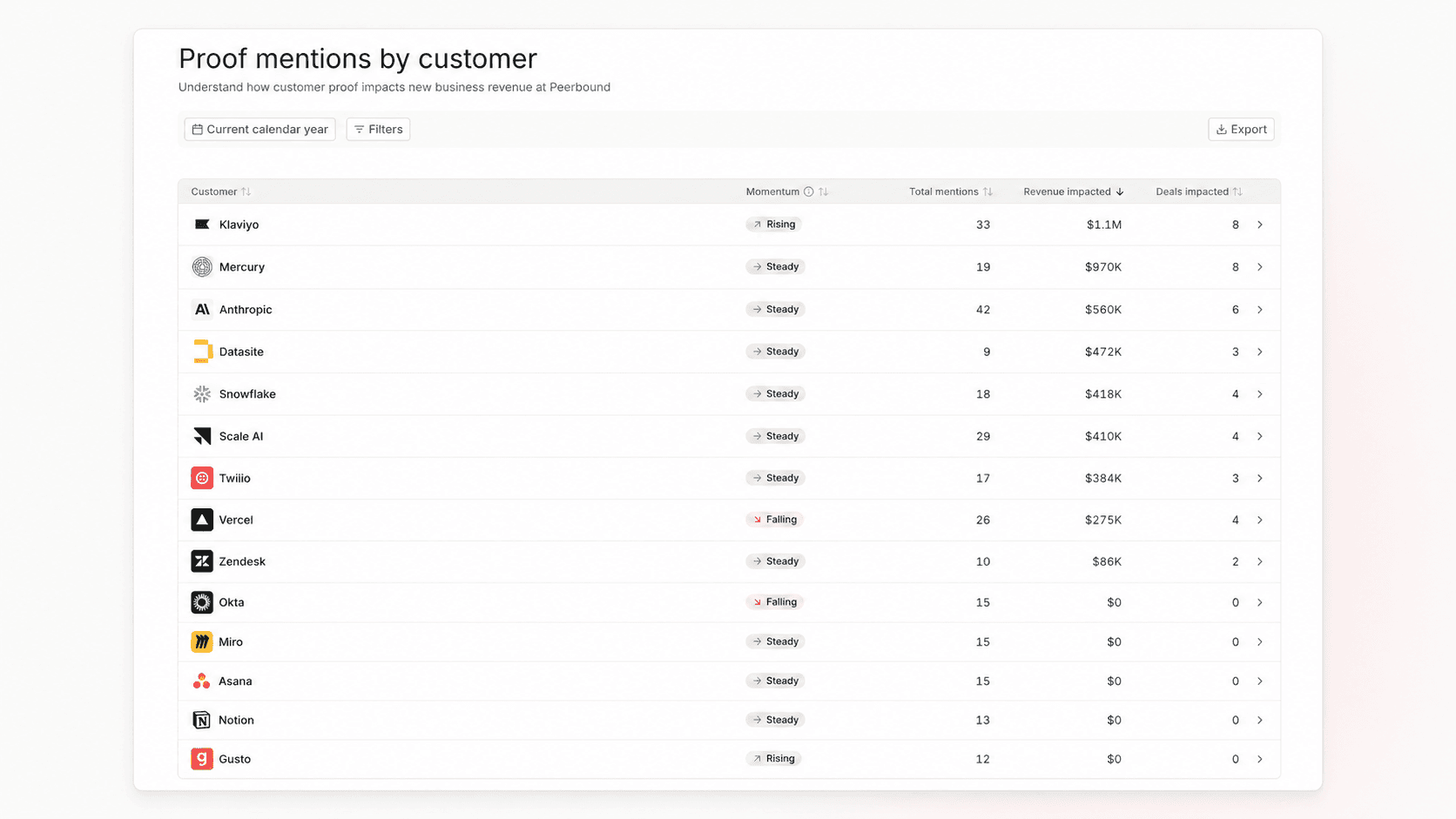
Once you get up and running with Peerbound Measure, you’ll be able to move beyond vanity metrics—like download counts, page views, and case studies published—to optimize against real business outcomes: revenue impact, win rates, and deal velocity. Pull up the trend chart before your next pipeline review or Quarterly Business Review and show, deal by deal, where proof showed up and what happened next.
Dalton explained the unlock of this exact scenario. “Our team just presented our QBR today, and Measure was a key input into the data that we shared—it's just information we wouldn't have had before. It's a huge new unlock for us, because before, in a QBR, we would have just talked about how many case studies we made, which no one at the executive level really cares about. Now, I can tell them exactly how much lift we're seeing with deals and the specific reps who've seen the most value from it.”
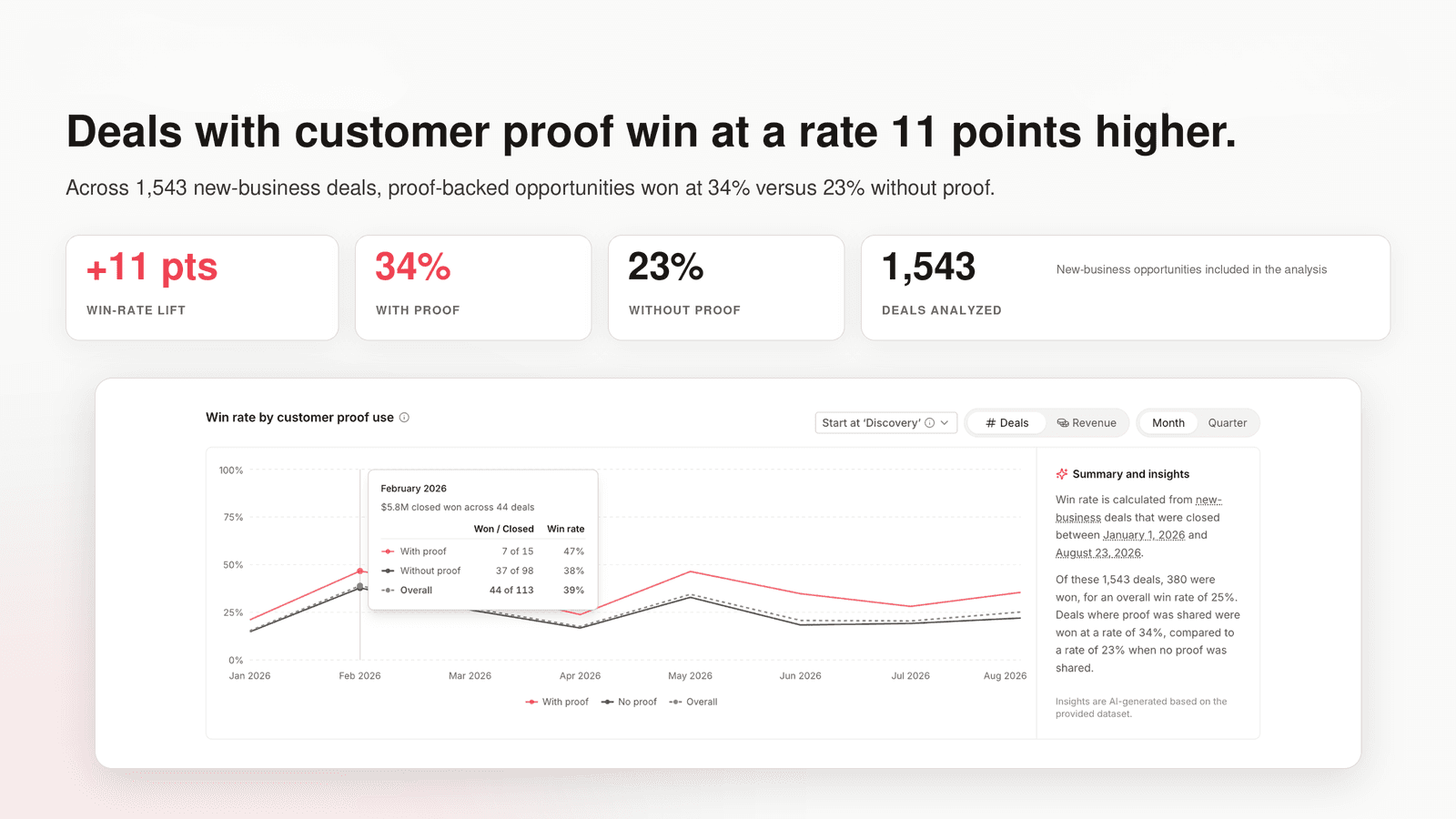
This opens up new lines of cross-functional partnership, especially between Customer Marketing and Sales Enablement. When you can see how much customer proof impacts win rates, deal size, or deal velocity, and who’s leading the charge versus which reps are behind the curve, you can collaborate on a tactical, actionable plan to turn things around—or even turn on Peerbound’s proof coaching agents to proactively follow up with those reps. Then, track in the dashboard whether or not your interventions are working.
Luis Gonzalez, Director of Customer Advocacy at Enable (a verified Peerbound customer) is also using Peerbound Measure to drive impact at his company. “It gives us data and a strategic way to show leadership that customer proof is hitting inboxes daily, and reps can prompt it in Teams and leverage it for high-value deals. The data shows our win rates are higher and deal sizes are bigger when customer proof is mentioned. Now we have strategic insight to guide sales leaders to push adoption.”
At Crunchtime (a verified Peerbound customer), that same shift changed how the work reads internally too. "Measure is really strong, fills a massive gap in our industry, and I'm really excited about it. I think Peerbound is going to help many other Customer Marketers keep their jobs and hopefully even get promoted faster," said Thao Littler, Senior Customer Marketing Manager at Crunchtime.
No Attribution Model to Configure, No Dashboard to Build
None of this requires a quarter spent configuring a multi-touch attribution model or building your own dashboard from scratch. Credit is self-driving, straight from the call and the CRM you already have connected. It's tied to what a rep actually said in a live conversation, not whether someone opened a file, and every number traces back to one rep, one call, one deal. Nothing gets split across a model after the fact.
Next SKO, when you get your ten minutes with the room, you’ll come with your own playbook that’s built to accelerate business growth, just like Demand Gen and Product Marketing. Keep the happy customer reel, but back it up with proof that these happy customers help your sellers win more deals.
By the time reps are back at their desks a week later, you'll be able to see whether the story you played is the one that follows them into a deal.
Book a demo to see how Peerbound Measure ties customer proof to revenue.