You are three reviews short of holding your spot on the Grid, and you are sending the same message you sent in Q1 and again in Q2. "Could you leave us a quick G2 review? Takes five minutes, I promise." Most of the people you send it to will not respond, because most outreach does not get a response.
While you wait, you finally do the thing every article about AI search tells you to do but you’ve never done. You open ChatGPT and type the question your buyer would type. "Best [your category] software for enterprise teams." It answers in about four seconds. It names two competitors and one company you have never once lost a deal to. It does not mention you.
Part of that answer traces back to your own homepage and company blog. But part of it, the part you have the least say over, came straight from the peer reviews you have been chasing since Monday morning.
By G2's own analysis, AI models now cite 80% of its product profiles more often than human buyers ever view them. AI has become the first thing that forms an opinion about your category, and when it forms that opinion it leans on peer-review consensus to do it. For years your reviews were a badge you displayed on a pricing page. Today they are raw material a model reads and repeats back to a buyer who never visits the review site at all. You cannot make a model recommend you. What you can influence is whether your review record is deep enough, current enough, and specific enough for the model to trust it and pass it along.
Where does AI get its opinion about your category?
Increasingly, from third-party review sites rather than from anything you publish yourself. Buyers used to open ten browser tabs. Now a large share of them open one chat window. Roughly half of B2B software buyers now begin their research inside an AI chatbot rather than a search engine, and in G2's 2025 buyer report, generative AI tools rank as the number-one influence on vendor shortlists, ahead of review sites, vendor websites, and salespeople.
When those tools answer a "best software for" question, they pull heavily from the same review platforms your team already works in. G2 is the fourth most-cited source on ChatGPT and ninth on Perplexity, the only B2B software marketplace in either top ten. Review platforms show up in more than a third of commercial AI Overviews, and three of the five most-cited domains overall are review sites. Even after these sites lost most of their human traffic over the last two years, Gartner Peer Insights, G2, and Capterra all held their place among the top five most-cited sources. TrustRadius sits in the same tier of third-party validation the models reach for. The referral clicks dried up. The influence moved into the answer itself.
It is worth being straight about the limits. The research here is young, and the numbers disagree, with studies estimating anywhere from a small fraction to about half of AI answers drawing on a brand's own website. What they agree on is narrower. AI leans on sources beyond your own website more than most marketers expect. And most teams are not yet watching this at all, since only about 14% of marketers currently track whether AI tools cite them.
So the goal is not to “win” AI search, and it is fair to be skeptical of anyone who says you can. The more useful goal is a smaller one. Peer reviews are one of the strongest surfaces a model uses to corroborate what it says about you, and one of the few you can actually feed.
What makes your reviews worth citing in AI search?
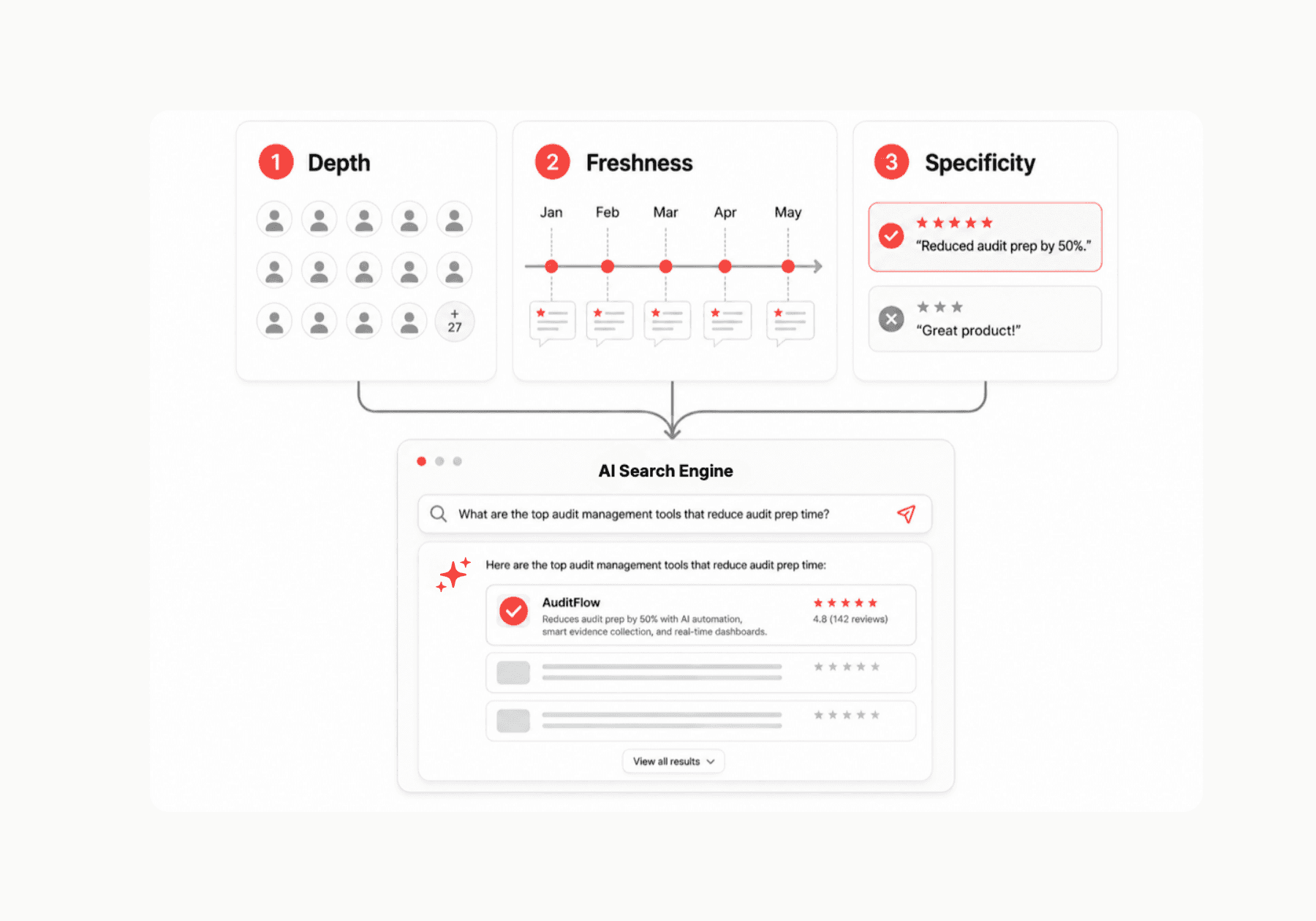
When you look at what actually moves a product from well-reviewed to well-represented in AI answers, the same three properties come up every time.
Depth. Volume is a signal because models detect sentiment at scale rather than trusting any single review. An analysis of thirty thousand AI citations across five hundred software categories found a clean relationship, where categories with about ten percent more G2 reviews earned roughly two percent more citations. Practitioners tracking this put a rough floor around fifty reviews before a model treats a profile as a reliable source at all. Below that, you are statistical noise.
Freshness. A model prioritizes recently updated sources and lets the rest age out, so a profile full of two-year-old reviews carries less weight than one with a steady cadence of recent ones. Content updated within the last thirty days earns roughly three times more AI citations, and Perplexity leans on recency harder than any major engine. A review program that fires once a quarter cannot produce that kind of cadence.
Specificity. This is the property most teams miss. A model matches a buyer's precise question to reviews that use precise language. If AI cites you for "CRM" but never for "pipeline forecasting," the fix is reviews that name pipeline forecasting the way a customer would say it. A wall of five-star reviews that say "great product, easy to use" gives a model nothing to match against. A review that describes a specific use case, in the buyer's own words, gives it exactly what it needs.
Depth, freshness, specificity. Those are the three things a review corpus needs, and they are precisely the three things the way most teams collect reviews cannot deliver.
Why doesn't chasing reviews the old way work anymore?
Because it puts the writing on the customer. The default ask starts from a blank page. You email a customer, usually after someone in leadership tells you to go move the number, and you ask them to sit down and write something from scratch. That single fact, that the work lands on them, is what breaks all three signals.
Depth suffers first. A blank-page request is a favor, and favors get deferred. Reply rates to outreach like this run in the single digits, and even a warm ask to an existing customer leaves plenty unanswered, so volume comes slowly and one relationship at a time.
Freshness is worse, because a blank-page ask is too heavy to run continuously. You save it for a push before a Grid report, collect a burst, and then go dark until the next deadline, which is exactly the sawtooth pattern a freshness-weighted model discounts.
Specificity barely happens at all. When a customer does write something unprompted, it is usually a warm, generic line or two, and you are in no position to ask a busy champion to please work in the phrase "pipeline forecasting." The reviews you fight hardest to get are the ones least likely to carry the specific language that earns a citation.
None of this is a knock on your program or your team. It is the shape of asking people to write their own reviews in 2026, when so many people have become dependent on an LLM to speed up their writing for them. Do that one customer at a time and you cannot build depth, cadence, and use-case specificity across a whole category. Remove the blank page and you can.
How does Peerbound turn customer calls into reviews AI will cite?
By writing the first draft for your customer, from words they already said. Instead of starting from a blank request, Peerbound listens to your customer calls and drafts a G2 review from what a customer actually said on a recording, so the review already carries the specific, use-case language a model looks for. The ask to the customer stops being "please write us something from scratch" and becomes "here is a draft in your own words, does this look right." That one change is what moves all three signals at once. More customers say yes, so depth grows. The engine runs continuously off calls that are already happening, so cadence stays fresh. And because each draft comes from a real conversation, the reviews name real use cases instead of defaulting to "great product."
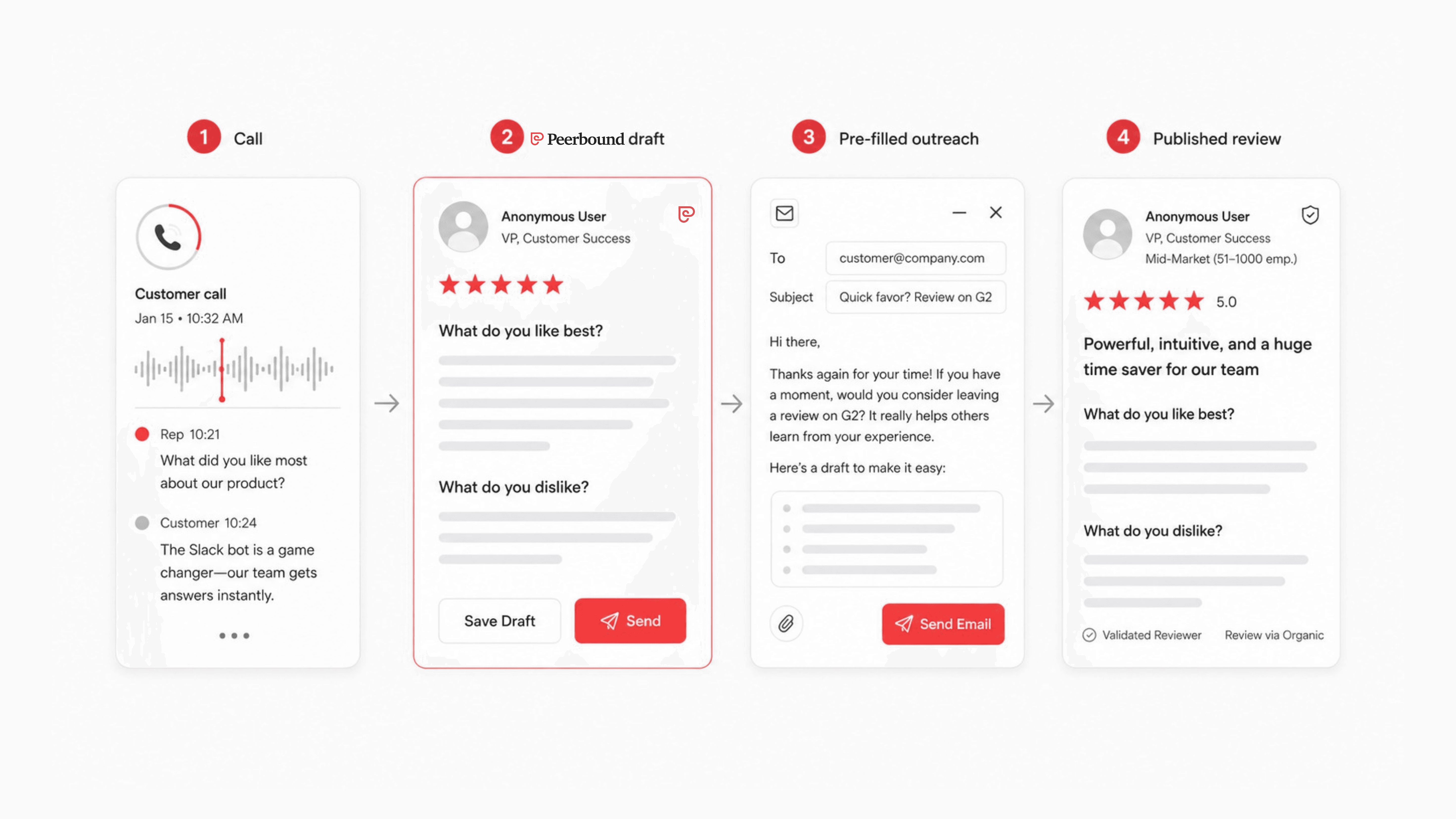
The clearest proof of the depth effect comes from Clari (a verified Peerbound customer). Pre-filled review outreach drawn from call recordings increased their G2 review conversion rate tenfold against prior manual campaigns. As Chris Dalton, former Director of Customer Marketing at Clari, put it in his own review, the AI-driven insights and pre-filled G2 templates boosted his results with G2 conversions increasing 10x compared to traditional outreach, and he cut the time he spent on sourcing and advocate work by about eighty percent. Dalton was not running a bigger outreach campaign. He was running the same motion with a draft already in hand.
The cadence effect shows up at Tipalti (a verified Peerbound customer), where a repeatable G2 generation workflow cut the time spent on review draft creation and approvals by seventy percent. A seventy percent faster workflow is what a steady, model-friendly review cadence actually looks like from the inside.
And the specificity effect is what Jane Menyo at Gong (a verified Peerbound customer) pointed to when she described the suggested-reviews feature as finding new advocates without duplicating effort: “The reviews were over two and a half times longer than our traditional reviews, which, in terms of impact, means better performance in SEO and AEO and greater visibility in those areas. The reviews also had twice as many product mentions and five times more value prop mentions. The review content we were able to get by serving up the types of conversations customers had already had with us directly back to them led to much more depth.” Menyo's team is not just collecting more reviews. They are surfacing the right advocates and turning real call language into review drafts, which is the part that makes a review worth citing rather than just worth counting.
Reviews have always been customer proof. What changed is who reads them first. It used to be a buyer scrolling your G2 page. Now it is a model assembling an answer before your buyer has typed your name. A review engine is how you make sure the proof it reads is deep, current, and specific enough to survive the trip into the answer.
Frequently asked questions
Do AI tools like ChatGPT and Perplexity actually use G2 reviews to recommend software?
Yes. G2 is the fourth most-cited source on ChatGPT and ninth on Perplexity, and review platforms appear in more than a third of commercial AI Overviews for software queries. When a buyer asks an AI tool for the best product in a category, peer reviews are one of the main sources it draws on to corroborate its answer, even though the buyer rarely visits the review site directly.
What about TrustRadius and Gartner Peer Insights? Do those matter for AI search too?
They do. Gartner Peer Insights and Capterra sit alongside G2 in the top five most-cited sources for software recommendations, and TrustRadius is in the same tier of third-party validation models reach for. The practical takeaway is that a presence on more than one review platform strengthens the consensus signal, since a product corroborated across several independent sources reads as more established to a model. Among them, G2 carries the heaviest citation weight for B2B software, which is why it is the most common place to start.
How many G2 reviews do I need before I show up in AI recommendations?
There is no guaranteed number, but the pattern is consistent. Categories with more reviews earn more citations, and practitioners tracking AI visibility often cite a rough floor around fifty reviews before a model treats a profile as a reliable signal. Depth matters more than any single five-star rating, because models read sentiment at scale rather than trusting one review.
Does it matter how recent my reviews are?
A lot. Models prioritize recently updated sources, and content refreshed within the last thirty days earns roughly three times more AI citations, with Perplexity leaning on recency harder than any major engine. A once-a-quarter review push produces a burst and then a long silence, which a freshness-weighted model discounts. A steady cadence of new reviews holds up far better over time.
How do I get more G2 reviews without chasing customers one by one?
Stop starting from a blank request. Peerbound listens to your customer calls and drafts a G2 review from what the customer already said, so instead of asking a busy champion to write something from scratch, you send them a draft in their own words to approve. Clari used this approach to increase G2 review conversion tenfold over manual outreach, and Tipalti cut its review generation and approval time by seventy percent.
Before you send another review request, run the query your buyer runs. Open ChatGPT, ask for the best software in your category, and see whether your customer proof made it into the answer. Then see how Peerbound turns the calls you are already recording into G2 review drafts your customers will actually approve. Book a demo.
AI tools like ChatGPT recommend software from peer reviews on G2, TrustRadius, and Gartner. Here's what they read in 2026 and how to make your customer proof count.