Key takeaways
AI favors specifics. Review content with real quotes and data is more likely to be cited than vague content.
A generic review request email typically converts under 1%. Those requests take more effort to answer, and higher effort tends to mean lower response.
G2 weights recency, so a review program that goes quiet for a quarter loses ground instead of holding steady. Collection works better as a standing habit than a quarterly push.
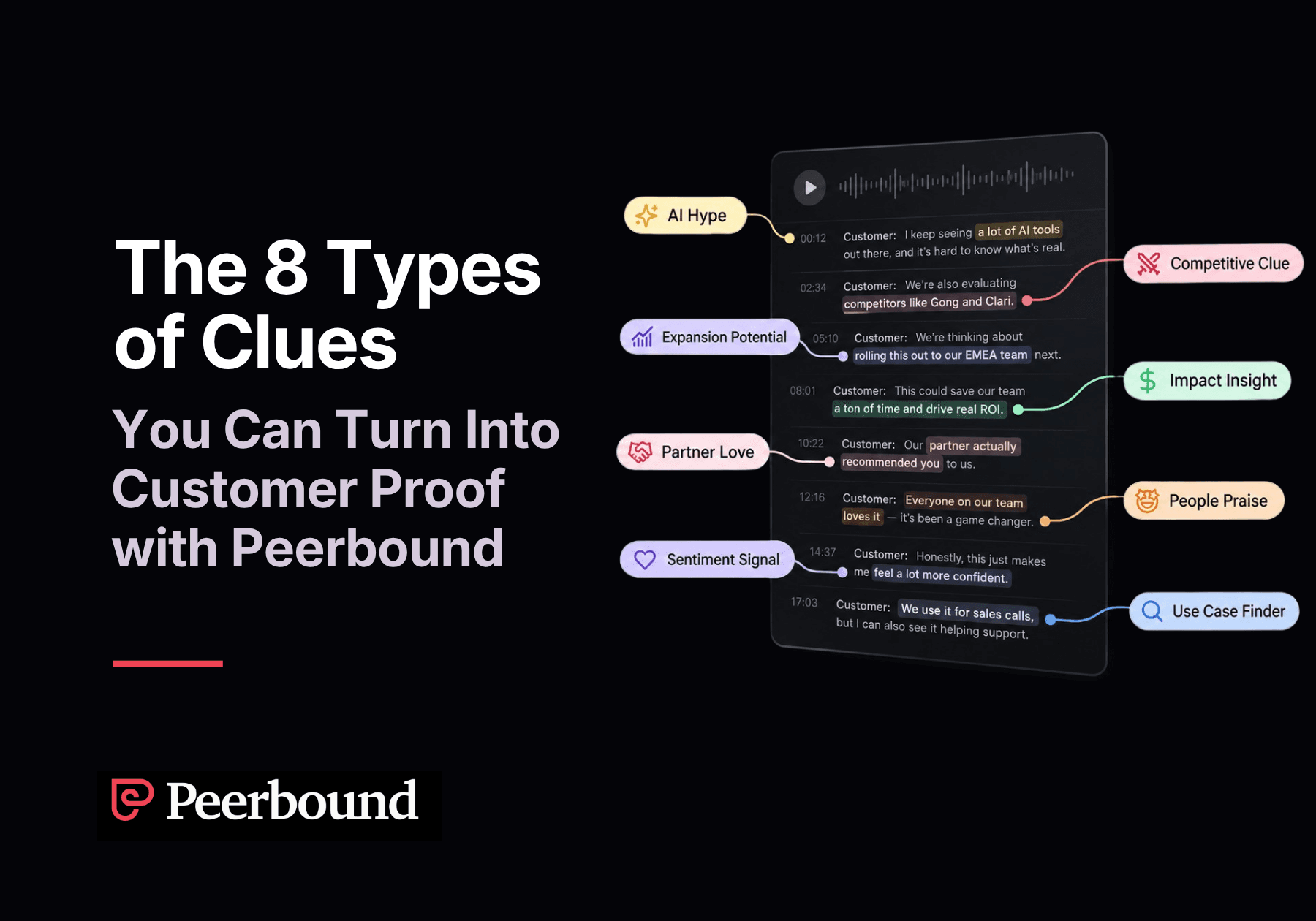
The best material for a G2 review already exists in your customer calls, and it usually gets forgotten once the call ends. Peerbound continuously pulls those Moments from your call recordings over time and, once a customer has said enough for a detailed review, Peerbound’s Create agent drafts one in their own words.
Why doesn't asking for a review get you the reviews you actually need?
Writing a G2 review from scratch takes real time, and it happens on the customer's already busy schedule, not yours. What most customer marketing teams actually send out isn't a drafted review; it's a blank request or a generic survey asking someone to start from scratch. A blank page with no clear starting point is an easy ask to defer, and most customers do.
Customers who push through anyway tend to be the most vocal, or the ones who already write reviews out of habit. That can narrow your reviews to one kind of company with one kind of problem, even when your actual customer base is much more varied.
Buyers researching a vendor aren't looking for customer proof in general. They are looking for someone who looks like them: a similar company size, a similar industry, solving the same problem. A long list of reviews from one kind of company profile does less for that buyer than a smaller set that reflects everyone who buys the product.
AI tools now do the same kind of matching, which makes a narrow set of reviews an even bigger problem. Enterprise buyers rank review platforms as their top research source, just ahead of AI search. And when those buyers turn to AI tools before talking to sales, the answers they get are built largely from the same reviews. If every review comes from one kind of company, those tools have nothing useful to offer buyers who don't fit that mold.
Fixing that starts with making the ask easier, so everyone beyond your most vocal customers has a reason to say yes too.
How does a call recording become a submitted G2 review?
Peerbound listens to the calls your team already records and pulls out the best quotes as they happen. That removes friction on both sides: the customer doesn't have to sit down and remember everything they said, and you don't have to dig through old calls to find it.
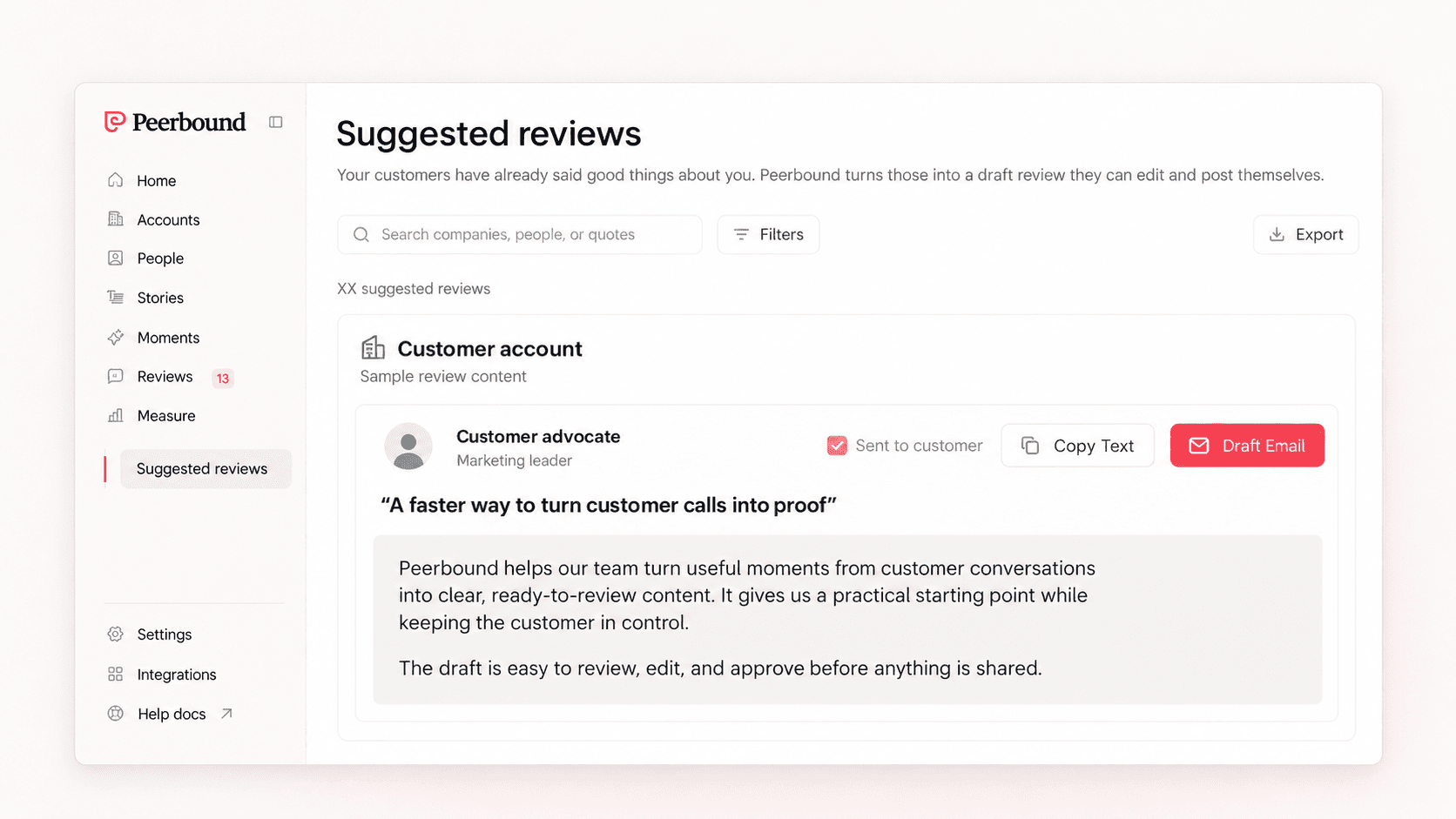
Peerbound tracks how many Moments, high-value customer quotes, and insights have built up for each account, and once there are enough for a detailed review, the Create agent drafts one and surfaces it as a suggested review. Each draft draws on everything Peerbound has gathered about that customer. It sounds like them and follows the pros-and-cons format G2 expects, but it also includes the proof points, numbers, and product details they mentioned on calls and would likely forget by the time they sat down to write. Those specifics are crucial to AEO, because AI tools are more likely to cite concrete details than general praise.
This is also how you get reviews from a wider range of customers, not just the usual few. Suggested reviews look across every account in Peerbound, so if you're short on reviews from a certain industry or company size, you can see which customers are ready to write one. And since you're not on every sales or CS call your company runs, this is often the only way you'd find out those advocates exist.
What does the review workflow look like in Peerbound?
Peerbound pulls real quotes and insights from your team's call recordings.
Once an account has enough Moments for a detailed review, Peerbound drafts a G2 review from what that customer actually said.
You open the Reviews section and browse the suggested reviews waiting for you.
You edit the review and the outreach email to match your voice and your relationship with that customer, and you choose who it comes from, whether that's you, a CSM, or whoever the customer knows best.
You send the draft to the customer for their own review and approval.
The customer edits it if they want to, then submits it to G2 under their own account.
The customer reads every word before it goes anywhere. The review that ends up on G2 is theirs, in their voice, submitted from their own account.
How do you ask a customer for a review without it feeling transactional?
The ask itself is usually harder than anything about drafting the review. Nobody wants to be the person who turns a good working relationship into a cold "please review us" email.
Because Peerbound starts with a draft, you're asking customers to confirm what they already said instead of writing a review from nothing."Here's what you told us on our last call. Would you mind posting this as a review?" is a smaller favor than "Would you write us a review?" even though the two are after the same thing.
Since the draft is already written, you can spend your time personalizing the ask. You and your CSM know the account history, whether this customer prefers a quick note or something more formal, and what your relationship with them is really like, so you can shape the message around that.
The ask doesn't go away, and the customer still has to agree, read the draft, and submit it. The difference is that you're asking for a few minutes of their time instead of an hour.
What does this look like in practice?
When Gong (a verified Peerbound customer) first started piloting Peerbound's review generation workflow, they saw richer reviews right away. "The reviews were over two and a half times longer than our traditional reviews, which, in terms of impact, means better performance in SEO and AEO," said Jane Menyo, Head of Solutions Marketing at Gong. The reviews also included twice as many product mentions and five times as many value prop mentions, which is the kind of specificity that’s captured when working from a live call instead of asking someone to summarize their feelings from memory weeks later.
Clari (a verified Peerbound customer) saw similar results. "With Peerbound's AI-driven insights and pre-filled G2 review templates, G2 review conversions increased 10x compared to traditional outreach," said Chris Dalton, Former Director of Customer Marketing at Clari, who also cut the time he spends on the task by about 80%.
How do you build a G2 review program that doesn't run out of steam?
One Peerbound customer shared that their cold review campaigns pulled from an NPS list or a Salesforce report commonly converted under 1% of the time. That rate doesn't mean the program is broken; it’s the normal result of asking a customer to write something from nothing. Teams that start from an already-drafted review instead of a blank request typically see that number move into the mid-single digits, several times over.
Reviews also lose value over time, which most teams don't plan for. G2 weights recent reviews more when it evaluates vendor rankings, so one strong quarter followed by three quiet ones won't hold your position for long. Reviews work better as a steady habit than a one-time campaign, and teams that treat them as campaigns usually end up starting over every time a G2 badge deadline comes around.
Keeping that habit going takes budget, and leadership is more likely to fund it when reviews are tied to pipeline instead of just review count. That case is getting easier to make, because AI tools now pull heavily from reviews to answer buyers' questions about a vendor, often before those buyers ever ask for a demo. Jane sees the same upside from Gong's pilot. "We believe this will result in longer-term business benefits," she said, and a big part of the reason is that a short review and a detailed one show up very differently in what an AI tool says about you.
What's coming next
Now it’s time for us to share some exciting updates.
Peerbound will soon support Gartner Peer Insights alongside G2, so you can drive reviews on both platforms without running a separate process. You'll also be able to send review requests straight from Peerbound in one click, even dozens at a time. If some time passes without a response, Peerbound will automatically send a reminder, so you don't have to. Customers will get a cleaner, branded request that comes from you or your CSM, and you'll be able to see what happens after each request goes out.
This week, a customer will tell your team exactly why they picked you, and if those words never make it into a review, the next buyer asking an AI tool about you may never hear them.
See how Peerbound turns your next call into your next G2 and GPI review. Book a demo.
Frequently asked questions
How does Peerbound help B2B SaaS companies get more G2 reviews?
Peerbound listens to the customer calls your team already records, and once an account has enough Moments for a detailed review, it drafts a G2 review based on what the customer actually said. You review and personalize the draft, then send it to the customer, who can edit it and submit it from their own G2 account. Because the customer is confirming their own words instead of starting from a blank page, they're far more likely to say yes.
What results have companies seen from Peerbound's G2 review feature?
Gong's reviews came back more than two and a half times longer than its traditional reviews, with twice as many product mentions and five times as many value prop mentions, according to Jane Menyo, Head of Solutions Marketing at Gong. At Clari, G2 review conversions increased 10x compared to traditional outreach, and Chris Dalton, former Director of Customer Marketing, cut the time he spent on reviews by about 80%.
How does Peerbound decide which customers to ask for a G2 review?
Peerbound suggests a review once an account has enough Moments captured from calls to support a detailed draft, and it prioritizes customers who haven't reviewed yet. That helps you hear from a wider range of customers instead of asking the same few accounts again, including advocates you might never have known about because you weren't on their calls.
Why do detailed G2 reviews matter for AI search?
Many buyers now ask AI tools about a vendor before they ever talk to sales, and those tools draw heavily on review content to answer. A detailed review with specific use cases, product features, and results gives an AI tool more concrete material than a short, general one. Peerbound's drafts include those specifics because they come straight from what customers said on calls.
How Peerbound turns Gong and Chorus call recordings into ready-to-send G2 review drafts, the workflow behind one team's 10x jump in review conversions.